Perplexity shipped its best product yet. It won't save them. Here's why — and what will save you.
Original article on Nate’s Substack
Date processed: 2026-03-20
Summary
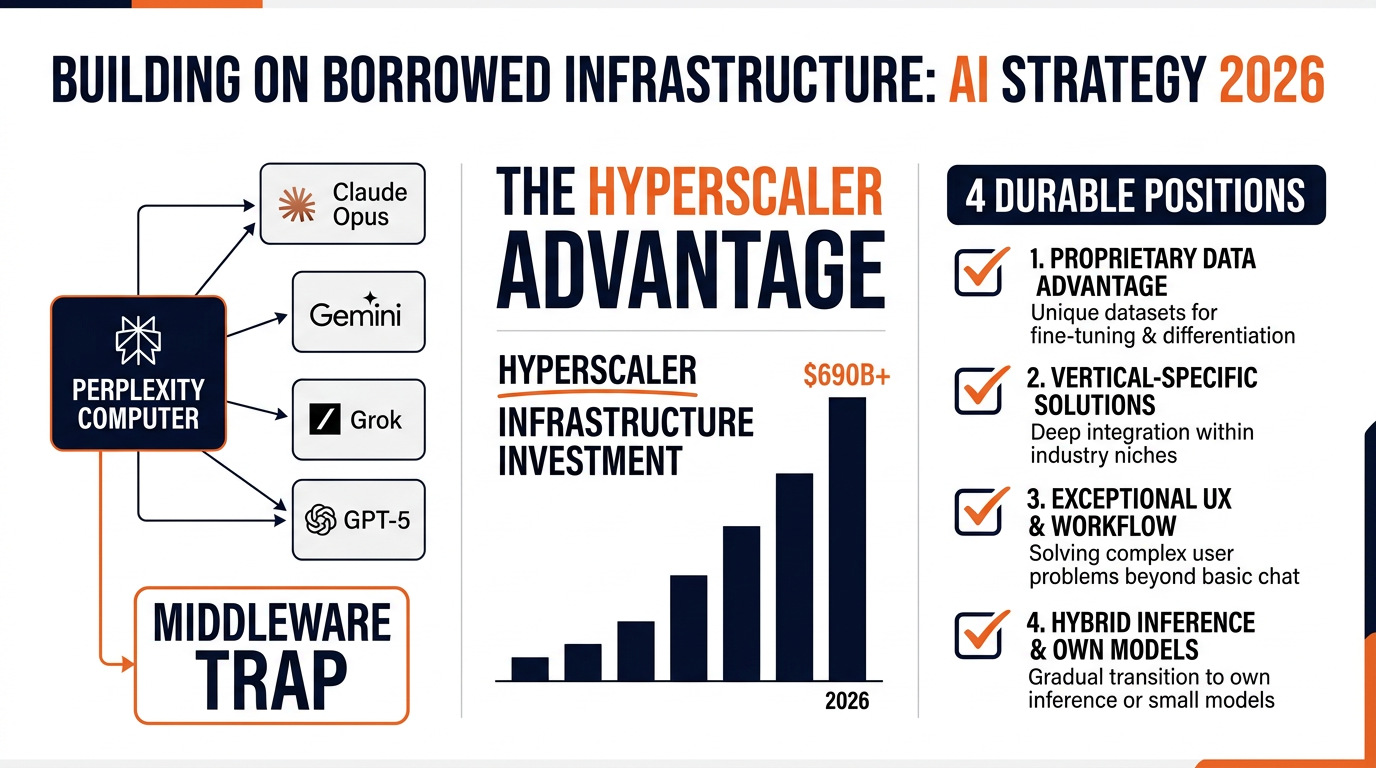
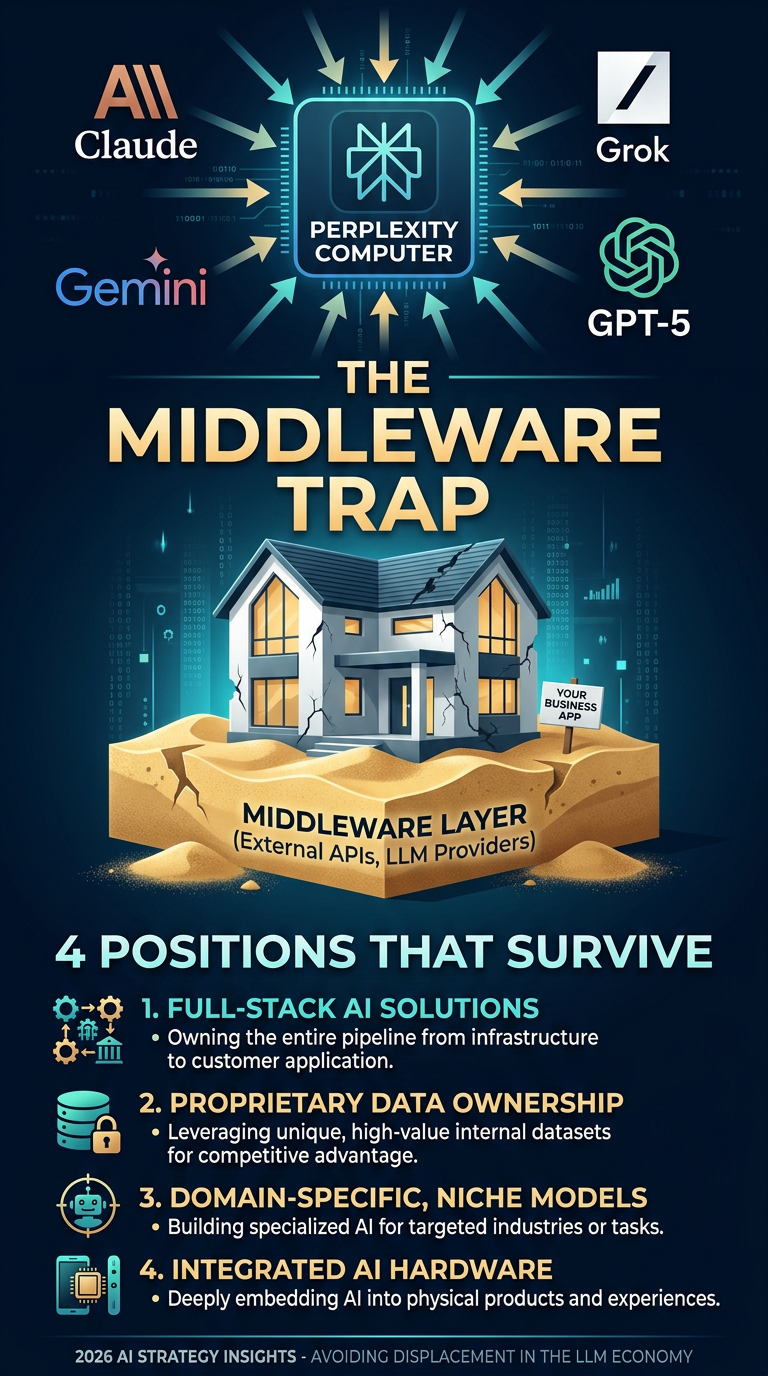
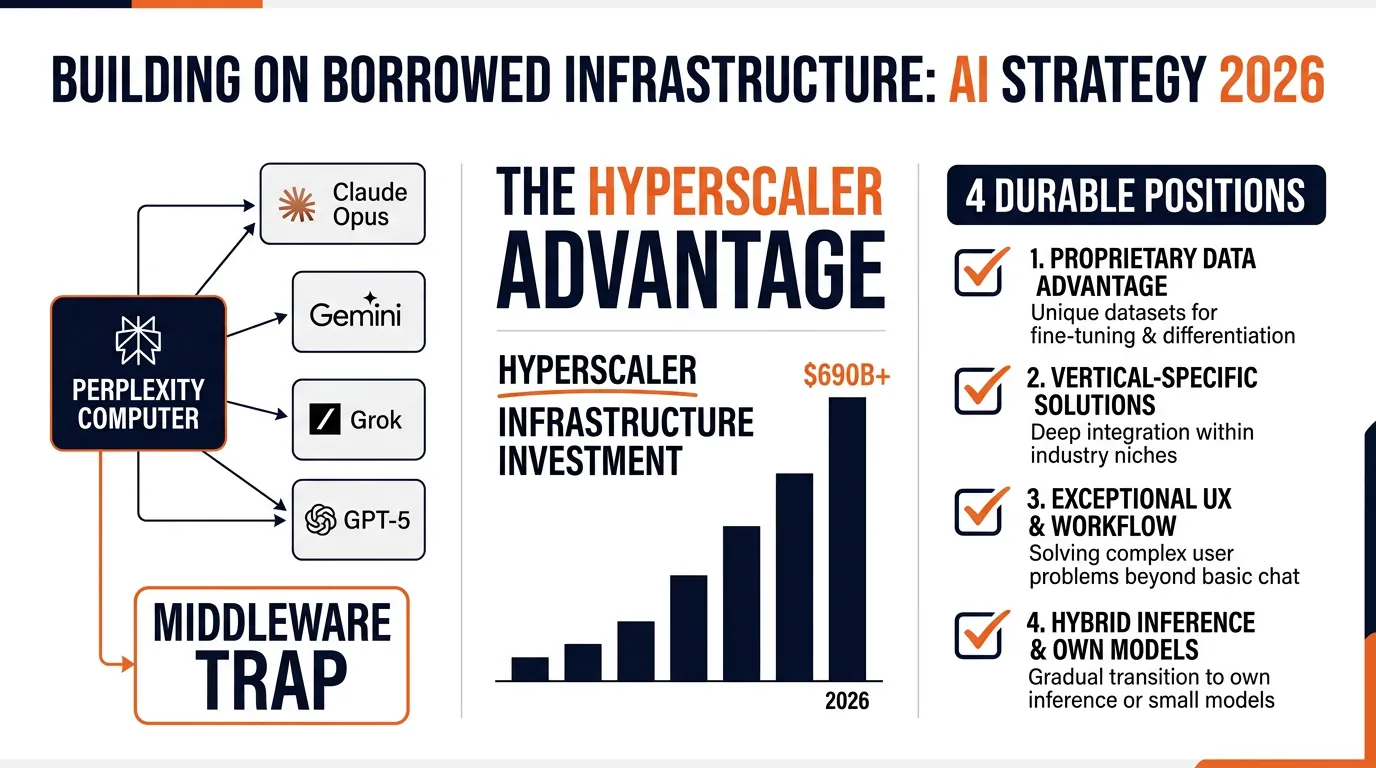
Main Thesis: Perplexity Computer is an impressive agentic product — but its structural dependence on competitors’ models illustrates a fatal flaw that threatens most AI companies today. Building on top of other companies’ foundation models is a “middleware trap” that good execution alone can’t escape.
Key Data Points:
- Perplexity Computer routes work across 19 frontier models (Claude Opus 4.6, Gemini, Grok, GPT-5.2), spawning sub-agents and delivering finished artifacts
- Priced at $200/month; Perplexity targets $656M in 2026 revenue
- The week Perplexity launched, Anthropic shipped Claude Cowork enterprise expansion — with one model they own outright
- Hyperscalers are investing $690B+ in infrastructure, widening the competitive moat
Key Argument: Perplexity’s reasoning core, research layer, and speed layer all depend on direct competitors. When those competitors extend vertically (like Anthropic’s Cowork), middleware players get structurally squeezed. This isn’t just Perplexity’s problem — it’s the position of almost every AI company that isn’t a hyperscaler.
The Diagnostic — 5-Step Test:
- Identify which AI capabilities your product depends on
- Map which of those are owned by potential direct competitors
- Measure how much of your value is in the orchestration layer vs. proprietary assets
- Assess whether hyperscaler vertical expansion eliminates your differentiation
- Determine which of the 4 durable structural positions you could realistically occupy
Four Positions That Survive:
- Full-stack AI solutions (own the model and the product)
- Proprietary data ownership (unique training data competitors can’t replicate)
- Domain-specific niche models (deep vertical specialization)
- Integrated AI hardware (hardware + software bundled)
Practical Takeaways:
- Evaluate your own company/client/portfolio: are you building on borrowed infrastructure?
- “Good execution on the wrong layer of the stack doesn’t save you”
- The hyperscalers’ $690B infrastructure bet makes the middleware trap worse every month
- Trust and distribution advantages (like Perplexity killing its ad business) matter, but structural position is more durable
Infographics