Executive Briefing: When Each Person Produces $2M a Year, the Sixth Team Member Costs Millions in Lost Productivity
Executive Briefing: When Each Person Produces $2M a Year, the Sixth Team Member Costs Millions in Lost Productivity
Source: https://natesnewsletter.substack.com/p/executive-briefing-ai-raised-output
Date Processed: 2026-03-09
Author: Nate (Nate’s Substack)
Summary
Main Thesis / Key Argument
Your excessive meeting culture isn’t caused by too many meetings — it’s caused by teams that are the wrong size. AI has dramatically increased per-person output (from ~$300K to $2M+/year at AI-native companies), but the cost of coordination between people has not decreased at all. This mismatch is compounding every quarter.
The optimal team size remains five people — backed independently by evolutionary psychology (Robin Dunbar), military doctrine (fire teams), and software engineering (Fred Brooks). What AI changed isn’t the number; it’s the consequences of getting the number wrong. And critically: the correct response to a 10x per-person multiplier is not to shrink your workforce — it’s to reorganize into small strike teams and radically expand your ambition.
Key Data Points & Findings
-
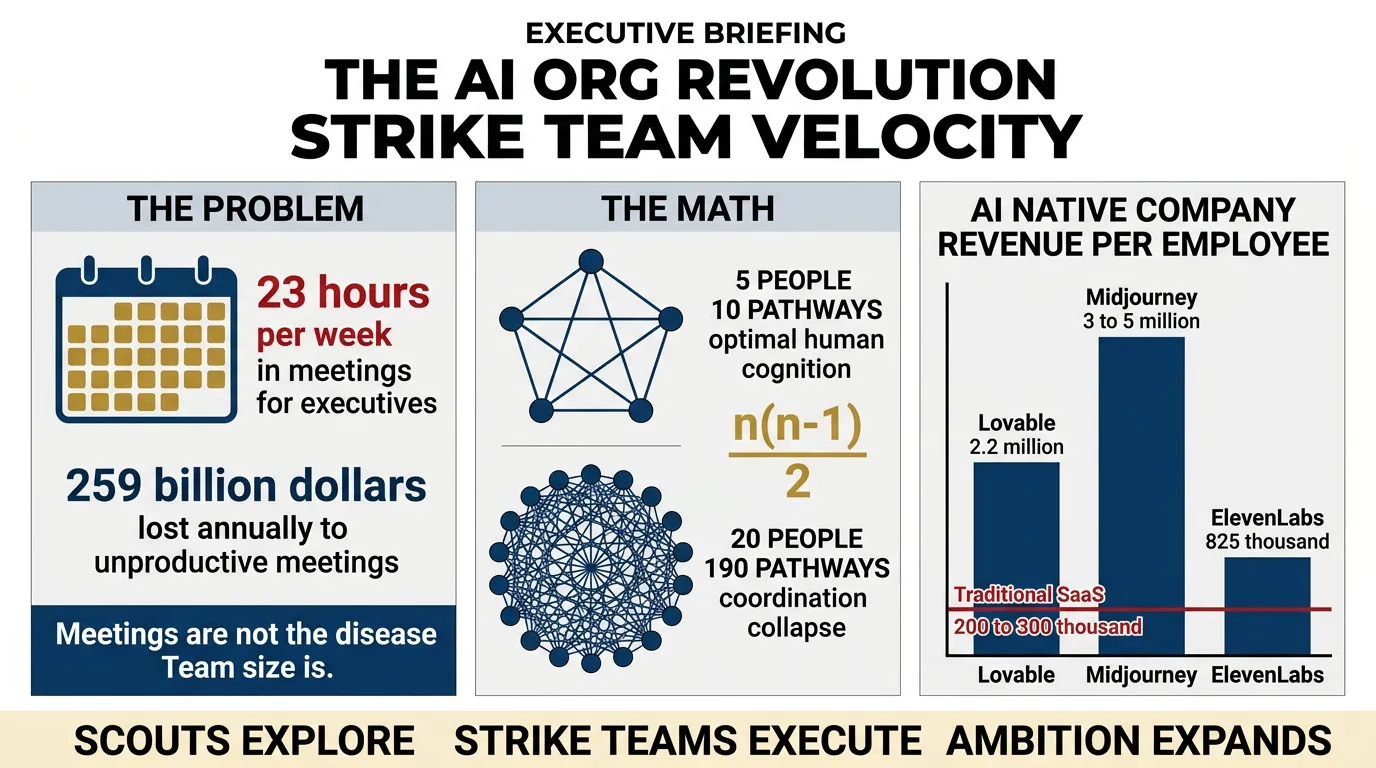
Meeting overload stats: Executives spend 23 hrs/week in meetings (Harvard Business Review). Meetings have tripled since 2020 (Microsoft data). U.S. businesses lose an estimated $259 billion/year to unproductive meetings.
-
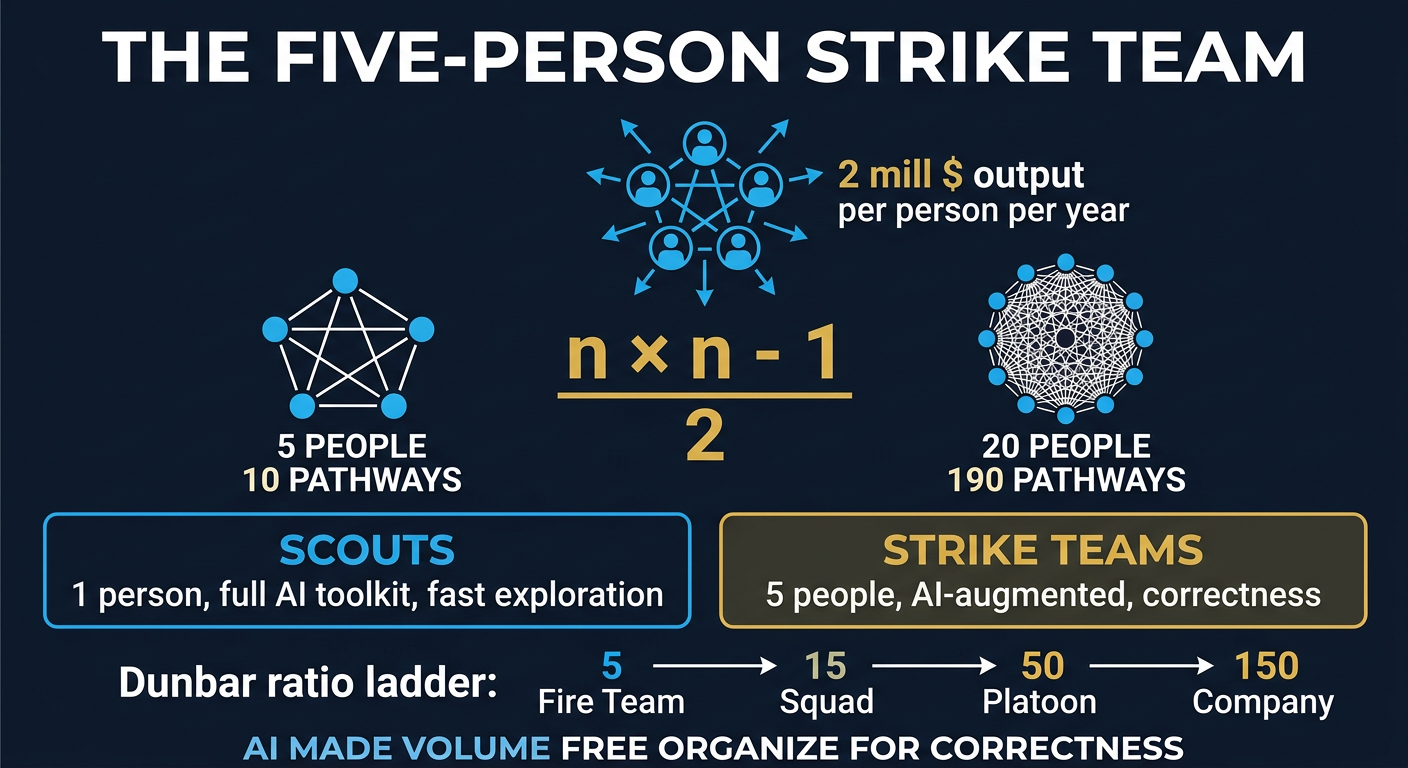
The combinatorics formula: n(n-1)/2 communication pathways. 5 people = 10 pathways. 20 people = 190 pathways. This is why larger teams drown in meetings.
-
Dunbar’s Number layers: 5 (core support), 15 (deep trust), 50 (meaningful working relationships), 150 (stable social connections). The military uses these exact ratios: fire team → squad → platoon → company.
-
AI-native company Revenue Per Employee:
-
Lovable: $2.2M RPE ($100M ARR with 45 employees by mid-2025; $200M ARR by late 2025)
-
Midjourney: $3–5M RPE (~$500M revenue, ~100–160 employees, zero external funding)
-
ElevenLabs: $825K RPE ($330M ARR by end of 2025 with ~400 employees)
-
Traditional SaaS benchmark: $200K–$300K RPE
-
-
Harvard/NBER study (P&G, 776 professionals): Teams using AI were 3x more likely to produce ideas in the top 10% of quality. AI also broke down functional silos — marketing and R&D people both produced more balanced, integrated ideas with AI.
-
Shopify’s Tobi Lütke: Adding a 6th person to a team causes “a 10x loss of productivity.”
-
The Steinberger case: Peter Steinberger built OpenClaw solo (in a language he’d never used) and attracted acquisition interest from Meta and OpenAI. Joined OpenAI Feb 2026.
Practical Takeaways
-
Organize for correctness, not volume. AI made volume virtually free. The scarce resource is now correctness — whether the thing you shipped is actually right. Teams optimizing for volume (big teams) will keep shipping things that don’t work. Teams of five optimize for correctness via shared mental models.
-
Use the Scout vs. Strike Team framework:
-
Scouts (1 person): Fast exploration. Maps territory. High ambiguity, low coordination. Ideal for prototypes, research, thesis-testing. One person’s judgment is the ceiling.
-
Strike Teams (5 people): Production-quality execution. Optimizes for correctness. Each person’s AI output passes through at least one other brain with enough context to catch real errors.
-
Scale via Dunbar ratios: 5 (strike team) → 15–20 (cluster, coordinated by 1 person for inter-team coherence) → 50–80 (strategic objective) → 150–300 (division limit). Mirror the military org: fire team → squad → platoon → company.
-
Write a real organizational constitution. Not values or a mission statement. Specific principles where a reasonable competitor would choose the opposite. This is the standard of “correctness” against which all AI output is verified. Without it, AI amplifies incoherence at the speed of inference.
-
The Steinberger Threshold: The minimum level of judgment required to direct AI agents toward correct output (vs. being directed by them). It’s not prompt engineering — it’s Lütke’s “context engineering”: specifying a problem so completely that agents can solve it without follow-up.
-
Run Scout Missions to identify talent. Give one person a real problem, a week, full AI tooling, and zero meetings. What you’re testing for: Can they define the problem without being told how? Do they know what “right” looks like (taste)? Can they hold the whole system in their head? Do they default to action or permission? Warning: results will NOT match your current performance reviews. Your best meeting-runners may fail; your most “difficult” autonomous builders may excel.
-
The Ambition Expansion (not headcount reduction): The correct question is NOT “how do I do the same thing with fewer people?” It’s “what becomes possible when every 5-person team has the capacity of a 50-person department?” AI-native companies (Lovable, Midjourney) didn’t shrink — they pursued missions 10x bigger than what their headcount traditionally allowed.
Frameworks Included
-
n(n-1)/2 coordination cost formula
-
Scout vs. Strike Team classification
-
Dunbar-ratio organizational nesting
-
The Steinberger Threshold (AI-direction capability benchmark)
-
Five Diagnostic Questions (see below)
Five Diagnostic Questions
-
Pick any person on your team. If you gave them 10 AI agents and complete autonomy, could they produce the output of a department? (If no → you’ve hired for execution capacity in a world where execution is automated)
-
How many of your teams have more than 5 people? For each, write down what the 6th person adds that specifically justifies the coordination cost.
-
Do you have a written constitution — not values, not a mission statement, but specific principles where a reasonable competitor would choose the opposite?
-
When was the last time a single person at your company built something from zero in less than a week that previously would have required a team of 10?
-
The big one: If you reorganized into strike teams of 5 with AI, what mission would you actually pursue? Not your current mission — what would you go after if headcount were no longer the constraint? The gap between that answer and what you’re doing is the ambition you’re leaving on the table.
Infographics
Portrait (9:16)
Landscape (16:9)
Prompt Kit
Source: https://promptkit.natebjones.com/20260225_iaa_promptkit_1
Prompt Kit: Restructuring Teams for the AI Era — From Meeting Overload to Strike Team Velocity
This kit operationalizes the core frameworks from the article: diagnosing coordination overhead, classifying work into scout and strike team missions, writing an organizational constitution, designing a Dunbar-ratio org structure, and reframing strategy around ambition expansion rather than headcount reduction. Five prompts, each targeting a distinct executive decision.
How to use: Run these in ChatGPT, Claude, or Gemini. The prompts gather your specific context through conversation — paste them in and the AI will ask what it needs. No editing required.
Prompt 1: Coordination Overhead Audit
Job: Calculates the communication pathway math across your teams and estimates the real cost of coordination bloat.
When to use: When you suspect your teams are too large but need hard numbers to make the case — to yourself, your board, or your leadership team.
What you’ll get: A team-by-team analysis showing communication pathways, estimated coordination cost as a % of productive capacity, and a prioritized list of teams where restructuring would unlock the most value.
What the AI will ask you: Your teams (names, sizes, rough functions), your industry, approximate revenue per employee or total headcount and revenue, and how many hours per week your people spend in meetings.
Prompt 2: Scout vs. Strike Team Mission Classifier
Job: Takes your current projects, initiatives, and backlog and classifies each as a scout mission (1 person, exploration) or strike team mission (5 people, execution), with specific assignment parameters.
When to use: When planning a quarter, allocating people to projects, or figuring out which work should move fast with zero coordination and which needs a dedicated team optimizing for correctness.
What you’ll get: A classified list of your initiatives with assignment type, team size, success criteria, timeline, and specific traits needed. Plus a flag for anything currently structured wrong.
What the AI will ask you: Your current projects and initiatives (even a rough list), what stage each is in, and what matters more for each — speed of learning or correctness of output.
Prompt 3: Organizational Constitution Builder
Job: Helps you write specific, falsifiable principles that define what “correct” looks like for your organization — not values, an operational constitution that strike teams use to verify AI output and make autonomous decisions.
When to use: When your teams can’t make independent decisions because there’s no shared standard of correctness. This is the prerequisite for the strike team model.
What you’ll get: A set of 8–15 specific organizational principles, each with the tradeoff it represents, a test for whether work complies with it, and an example of how a reasonable competitor would choose the opposite. Plus a gap analysis on where your current stated values fail the specificity test.
What the AI will ask you: Your company’s current mission/values (to stress-test), what you build, who you serve, key decisions that define your company’s identity, and — critically — what you’ve chosen NOT to do and why.
Prompt 4: Strike Team Restructuring Blueprint
Job: Designs a concrete org restructuring plan from your current structure into strike teams of five, nested at Dunbar ratios, with the coordination and taste layers defined.
When to use: After running the Coordination Audit (Prompt 1) and building your Constitution (Prompt 3). This is the structural design step.
What you’ll get: A restructuring blueprint showing team compositions, Dunbar-ratio nesting (teams → clusters → divisions), which coordination roles survive and which become taste roles, a transition sequence, and an honest assessment of where this will break.
What the AI will ask you: Your current org structure (functions, teams, sizes, reporting lines), your key capabilities and domains, your Constitution (or a summary), and how much organizational disruption you can absorb at once.
Prompt 5: Ambition Expansion Strategy
Job: Reframes your strategic conversation from “same mission, fewer people” to “same people, 10x mission.” Identifies markets, products, and opportunities that become accessible when your strike teams operate at AI-augmented capacity.
When to use: At a leadership offsite, board prep session, or any strategic planning conversation where the default framing is cost efficiency.
What you’ll get: A strategic reframe document showing your current mission scope versus what becomes possible with AI-augmented strike teams. Specific new fronts — markets, products, customer segments, capabilities — with a rough feasibility assessment. The ambition gap quantified. And the competitive threat: who’s smaller and faster and already closing it.
What the AI will ask you: Your current business (products, markets, customers, headcount, rough revenue), what you’ve historically said no to because you couldn’t staff it, and what your competitors are doing that you’ve been unable to match.
Infographics