AI Agents Weekly - GPT-5.3 Codex Spark
AI Agents Weekly: GPT-5.3-Codex-Spark, GLM-5, MiniMax M2.5 & More
From Elvis Saravia’s AI Newsletter — February 14, 2026
Main Thesis
This edition covers a wave of major AI model releases and agentic AI developments, highlighting rapid progress in autonomous coding agents, open-source frontier models, and the expanding capabilities — and risks — of next-generation AI systems.
Key Stories (Accessible Content)
🔥 GPT-5.3-Codex-Spark (OpenAI)
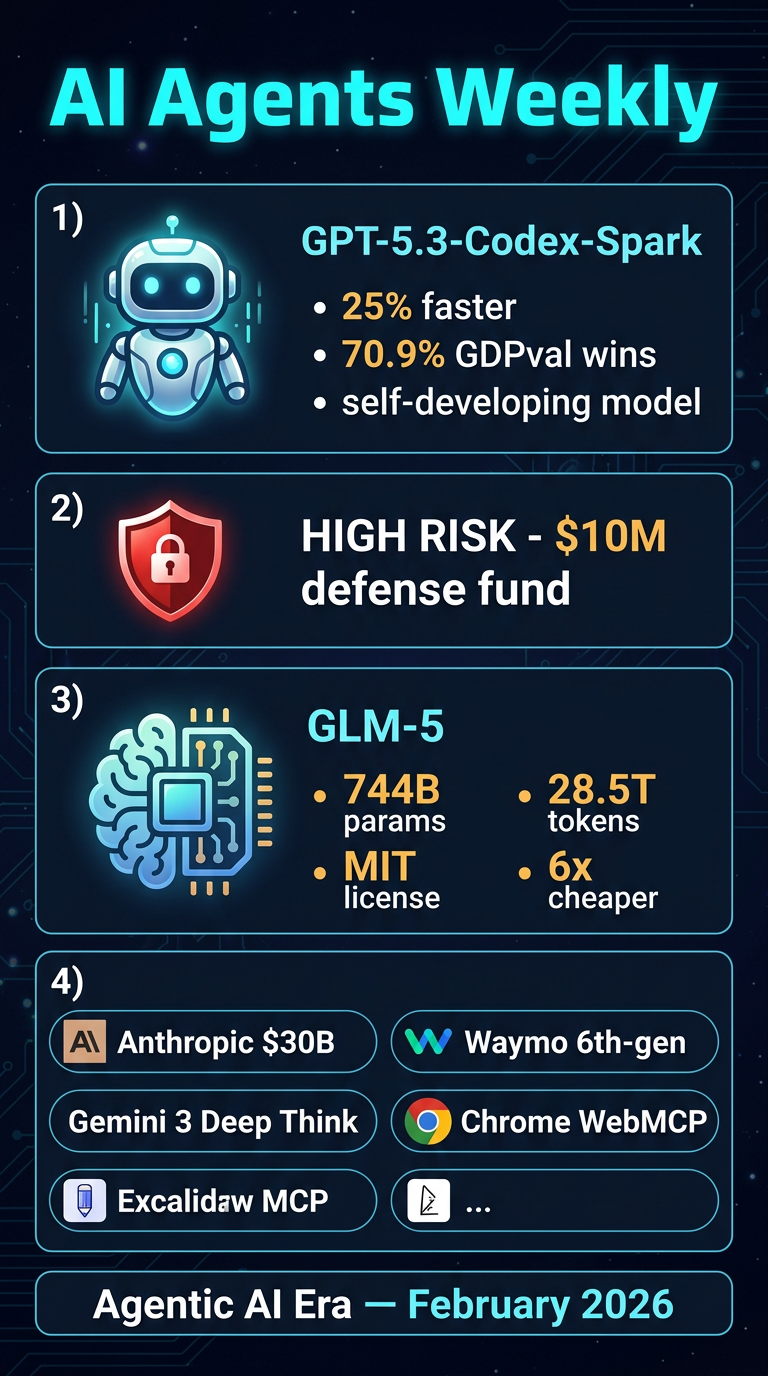
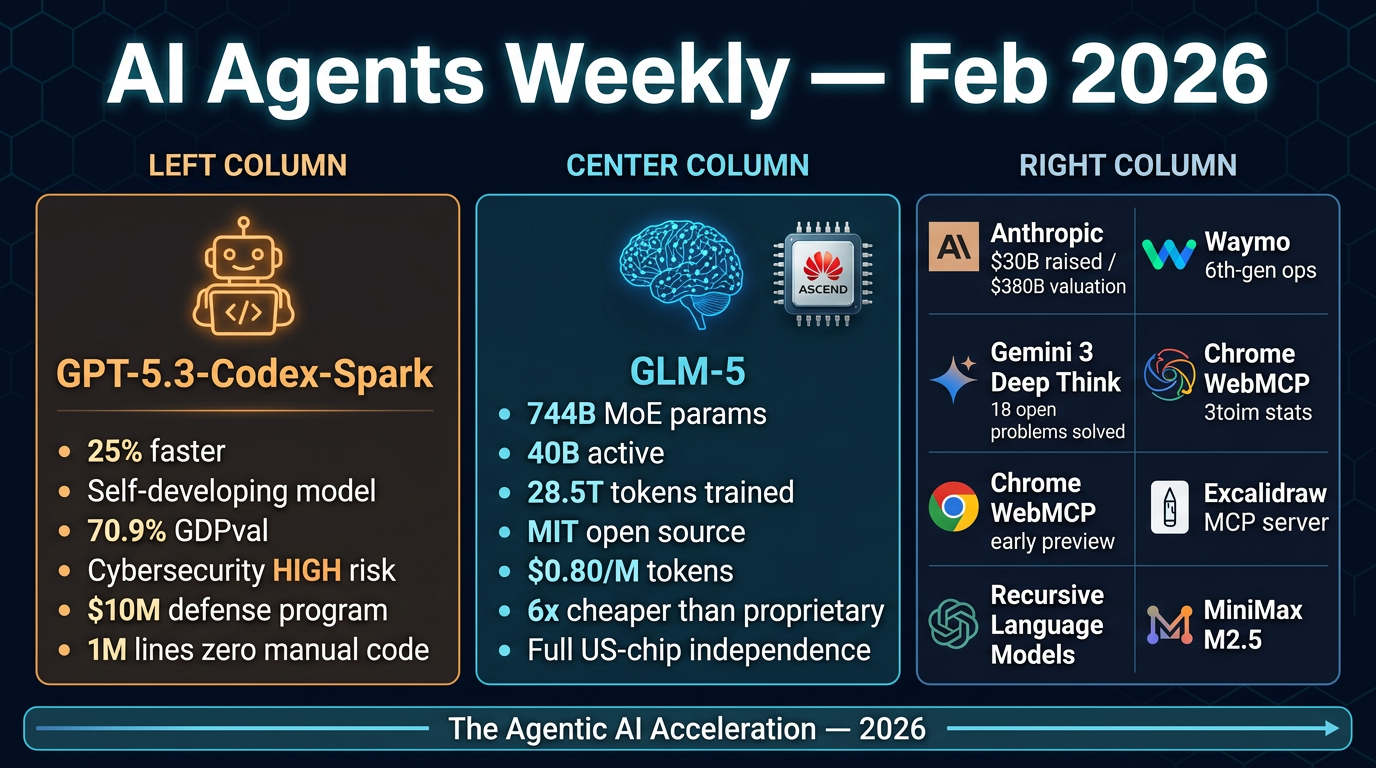
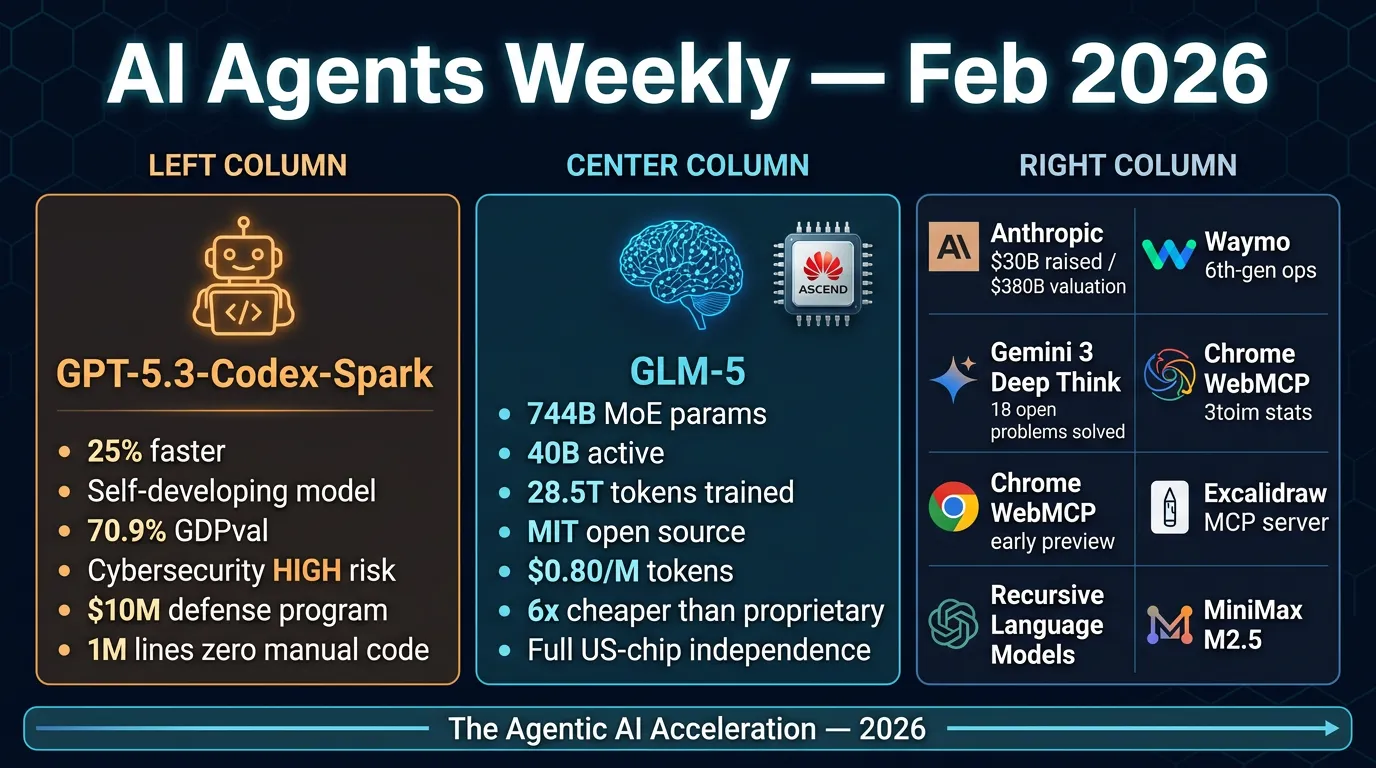
- OpenAI’s most capable agentic coding model to date, running 25% faster than its predecessor.
- Self-developing milestone: Used early GPT-5.3 versions to debug its own training, manage deployment, and diagnose evaluations — making it the first OpenAI model instrumental in its own creation.
- Beyond coding: Handles professional knowledge-work outputs including presentations, spreadsheets, and documentation. Wins or ties 70.9% of evaluations on the GDPval knowledge-work benchmark.
- Cybersecurity flag: Rated as OpenAI’s first model hitting “high” cybersecurity capability under their Preparedness Framework — meaning it could meaningfully enable real-world cyber harm if misused. OpenAI announced a $10M API credits program for cyber defense research in response.
- Notably, OpenAI reportedly shipped 1M lines of code with zero manual code using this model.
🧠 GLM-5 (Zhipu AI)
- A 744B-parameter Mixture-of-Experts (MoE) model with 40B active parameters, built specifically for agentic intelligence and multi-step reasoning.
- Hardware independence: Trained entirely on Huawei Ascend chips using the MindSpore framework — representing full independence from US-manufactured semiconductors.
- Agent Mode: Native autonomous task decomposition — breaks high-level objectives into subtasks with minimal human intervention. Can convert raw prompts into professional
.docx,.pdf, and.xlsxdocuments. - Training scale: Pre-trained on 28.5 trillion tokens (a 23.9% increase over GLM-4.7), using a novel RL technique achieving record-low hallucination rates.
- Open source & affordable: Released under MIT license with open weights. Available on OpenRouter at ~$0.80/M input tokens and ~$2.56/M output tokens — roughly 6x cheaper than comparable proprietary models.
- Competitive with frontier models across coding, creative writing, and complex problem-solving.
Additional Headlines (Paywalled — Titles Only)
- MiniMax M2.5 — New open-source model drop
- Recursive Language Models — Replacing context stuffing
- Agentica — Pushing ARC-AGI-2 with recursive agents
- Chrome WebMCP — Early preview launched
- Anthropic — Raises $30B at $380B valuation
- Excalidraw — Launches official MCP server
- Hive agent framework — Evolves at runtime
- Waymo — Begins 6th-gen autonomous operations
- Gemini 3 Deep Think — Solves 18 open mathematical/scientific problems
Practical Takeaways
- Agentic coding is maturing fast — GPT-5.3-Codex-Spark represents a new class of self-improving models that can participate in their own development cycle.
- Open-source is competitive — GLM-5 shows that MIT-licensed, open-weight models at frontier scale are now viable and dramatically cheaper than proprietary alternatives.
- Hardware geopolitics matter — GLM-5’s full Huawei/Ascend stack signals a credible alternative AI hardware ecosystem independent of NVIDIA/US chips.
- Cybersecurity risks are escalating — OpenAI’s own Preparedness Framework flagging a “high” risk level is a serious signal; developers should monitor AI safety guidelines closely.
- MCP (Model Context Protocol) is expanding — Both Chrome and Excalidraw launching MCP integrations suggests the protocol is becoming infrastructure-level for agentic AI.
Note: No arXiv papers were linked or cited in the accessible portion of this article.