AI Agents Weekly: AI Labor Market
AI Agents Weekly: AI Labor Market Impacts & More
From Elvis Saravia’s AI Newsletter — March 7, 2026
Main Thesis
This issue covers a broad sweep of AI agent developments, with the headline story being Anthropic’s new framework for measuring AI’s real-world impact on the labor market — moving beyond theoretical capability to actual usage data.
🔑 Top Stories (Accessible Content)
1. 📊 Labor Market Impacts of AI (Anthropic)
Anthropic published a new framework introducing “observed exposure” — a metric combining theoretical LLM capability with real Claude usage data from the Anthropic Economic Index.
Key Findings:
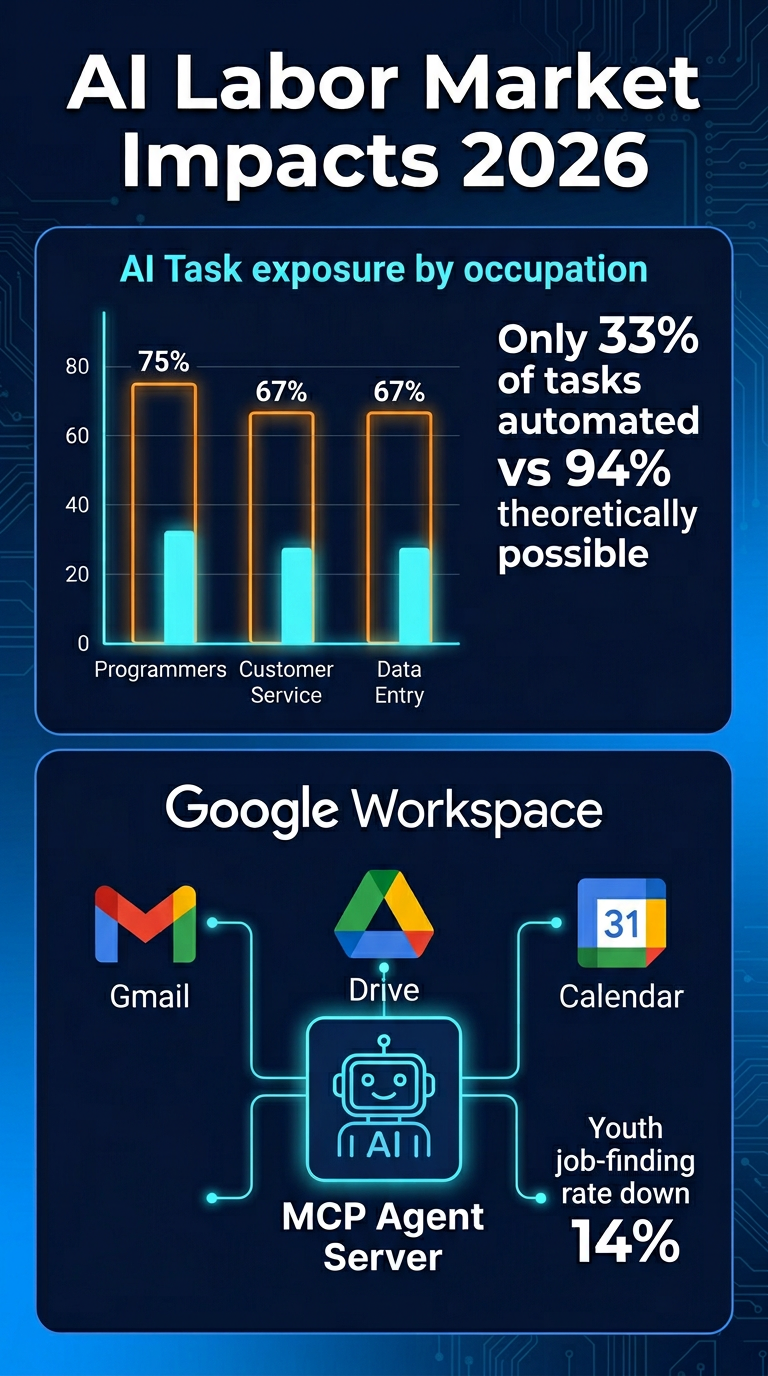
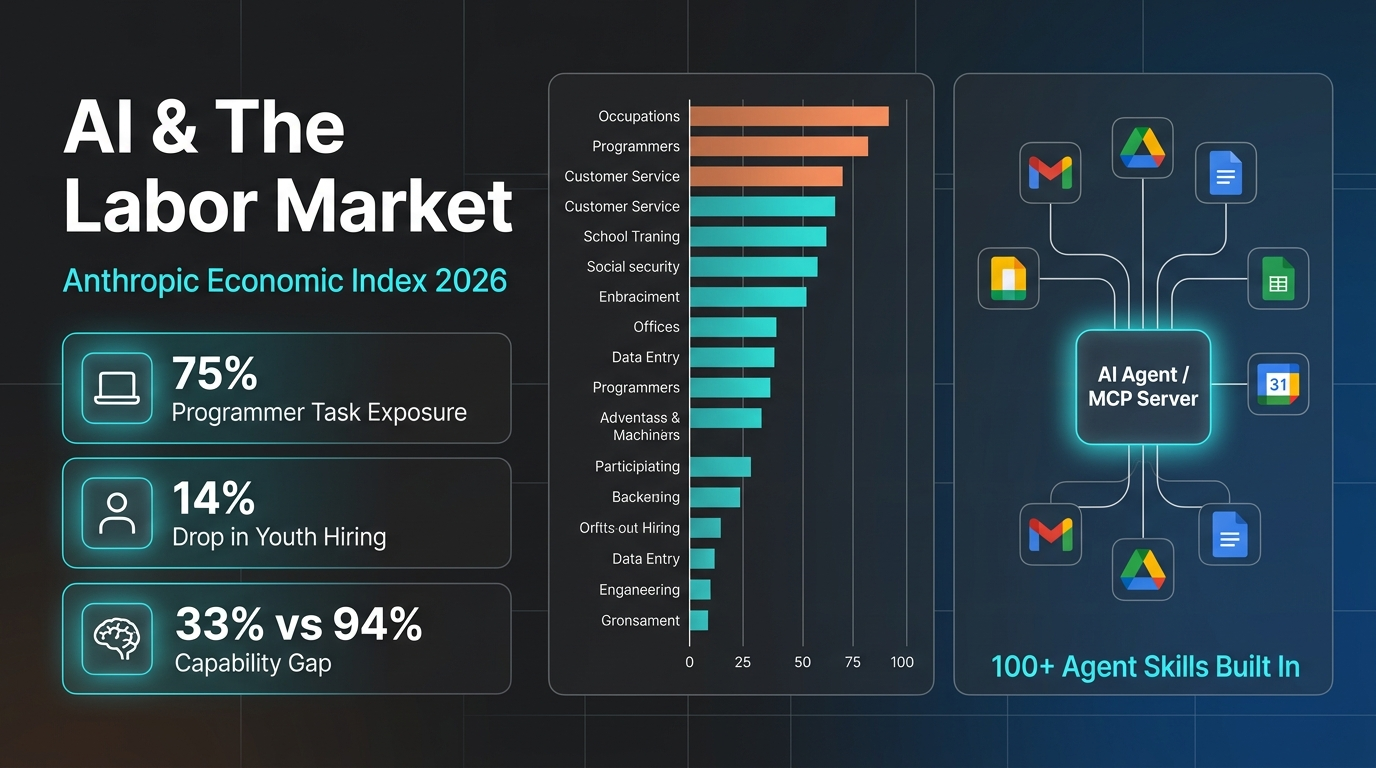
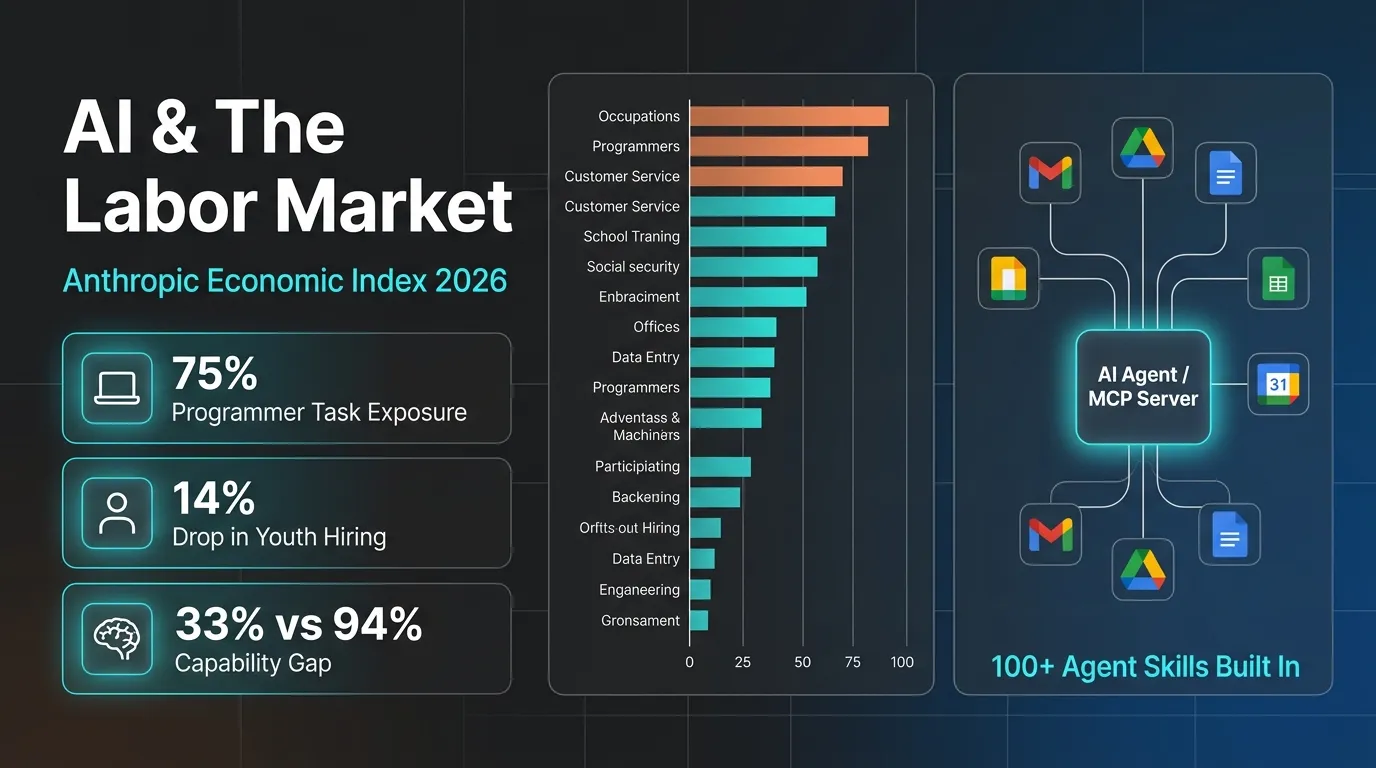
- Programmer exposure is highest: Computer programmers show 75% task coverage, followed by customer service reps and data entry keyers at 67%
- No unemployment signal yet: Analysis of Current Population Survey data shows no systematic unemployment increase in highly-exposed occupations since late 2022 (framework sensitive to ~1 percentage point changes)
- Youth hiring slowdown: Workers aged 22–25 in exposed occupations saw a 14% drop in job-finding rates vs. 2022, corroborating findings from Brynjolfsson et al. using ADP payroll data
- Massive capability gap: Claude currently covers only 33% of tasks in Computer & Math occupations, despite 94% being theoretically feasible — signalling significant future displacement potential as adoption deepens
Practical Takeaway: AI displacement is real but uneven and still early-stage. The greatest near-term risk is in coding, support, and data roles — and among young workers entering the job market.
2. 🖥️ Google Workspace CLI
Google released an official command-line tool for its Workspace APIs (Drive, Gmail, Calendar, Sheets, Docs, Chat, Admin) — built in Rust, distributed via npm, and dynamically generated from Google’s Discovery Service.
Key Features:
- 100+ agent skills with structured SKILL.md files and 50 curated workflow recipes
- Built-in MCP server allowing AI assistants (Claude, Gemini, etc.) to connect and operate on Workspace programmatically
- Dynamic API coverage — auto-updates as Google ships new APIs, no hardcoded endpoints
- Agent-first design — structured metadata, input/output schemas, and example prompts make it immediately usable by coding agents and automation pipelines
Practical Takeaway: Google Workspace is now a tool-callable environment for AI agents, dramatically lowering the barrier for building agentic workflows on top of everyday productivity tools.
📰 Other Headlines (Paywalled — Titles Only)
- GPT-5.4 launched by OpenAI with native computer use
- Exa Deep puts an agent inside every search
- Cognition previews SWE-1.6 training run
- Gemini 3.1 Flash-Lite drops with significant gains
- Qwen 3.5 small model series released
- Liquid AI releases LFM2-24B-A2B model
- Cursor lands in JetBrains via ACP
- OpenAI Codex Security Agent launched
- OpenAI publishes CoT Controllability research
- Claude Opus hacks its own benchmark eval
📄 Papers Mentioned
- Brynjolfsson et al. (ADP payroll data study on AI labor market effects) — no direct arXiv link provided in accessible content
🧠 Key Takeaways
- AI labor displacement is measurable and underway, but lagging far behind theoretical capability
- Young workers and programmers face the sharpest near-term risk
- Google’s Workspace CLI signals a shift toward infrastructure-level AI agent support from major platforms
- The gap between what AI can do and what it is doing in workplaces remains large — but is closing