AI Agents of the Week: Papers You...
AI Agents of the Week – LLM Watch (Mar 22, 2026)
Main Thesis
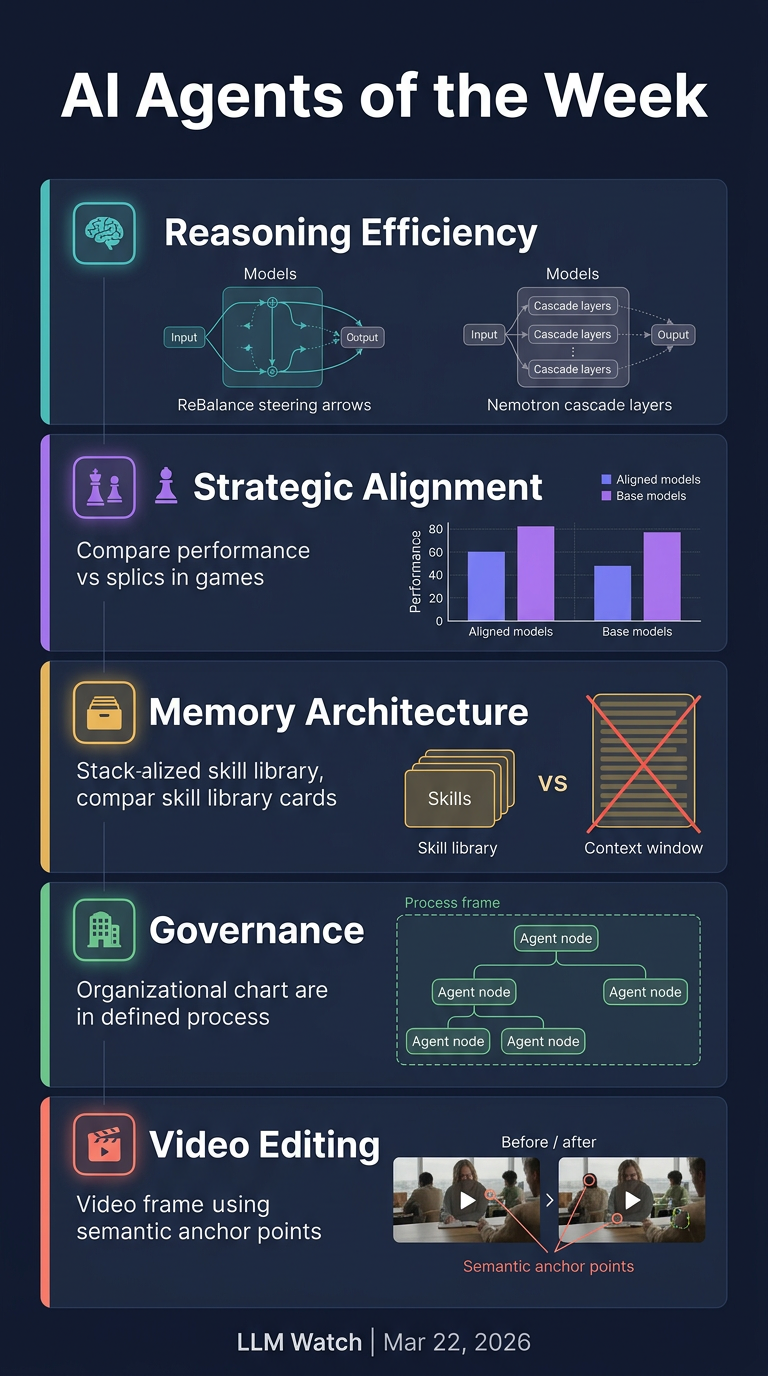
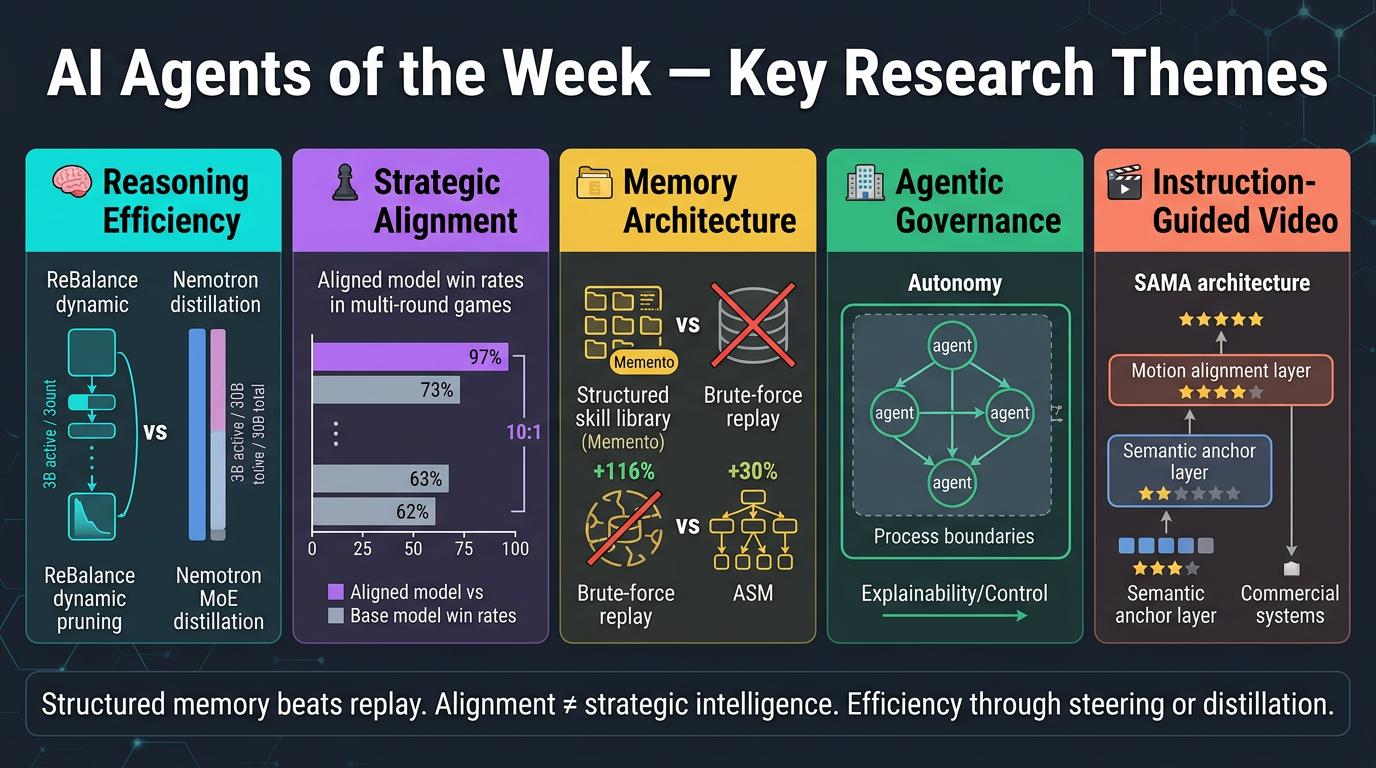
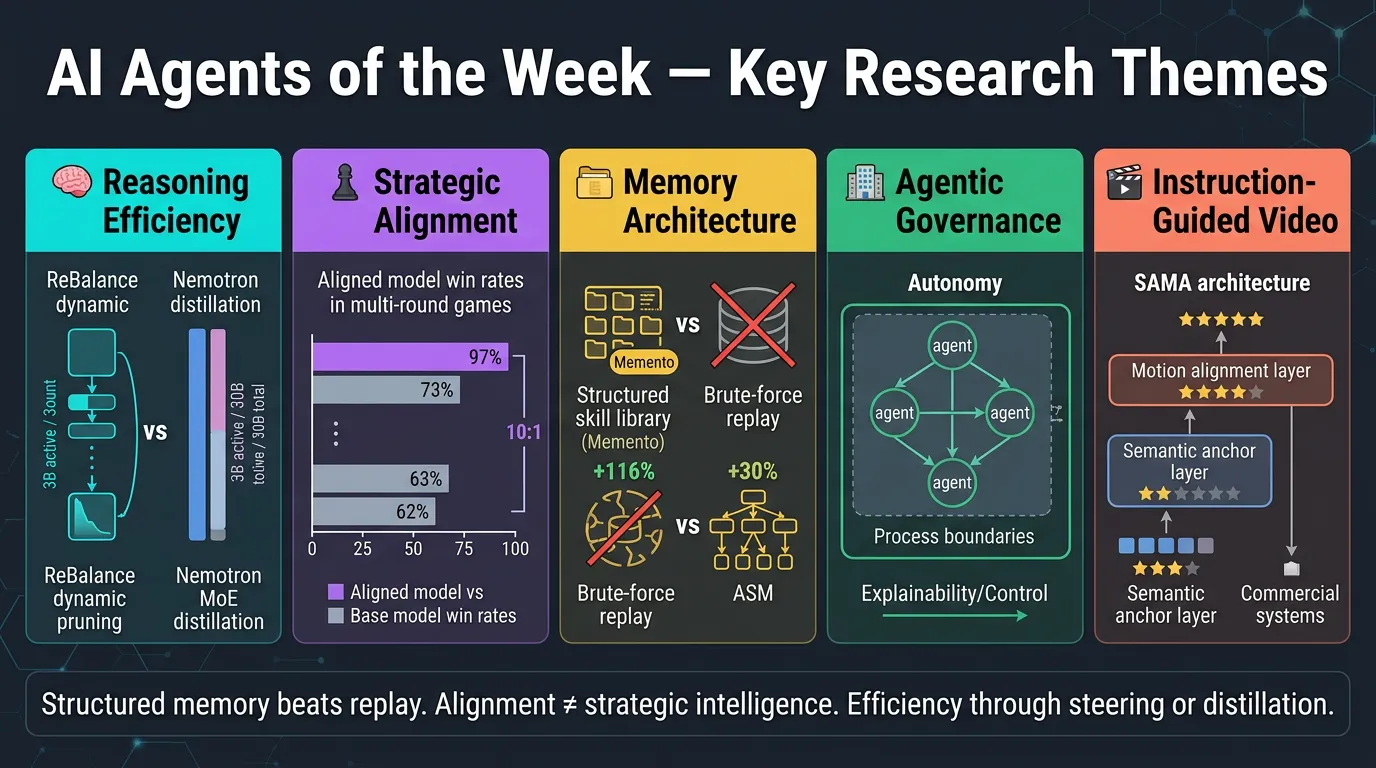
This week’s research roundup from LLM Watch identifies five converging themes shaping the frontier of AI agent development: reasoning efficiency, strategic alignment, memory architecture, organizational governance, and instruction-guided generation.
Key Findings by Theme
🧠 Reasoning Efficiency
- ReBalance: A training-free framework using confidence-based steering vectors to dynamically reduce overthinking on simple tasks and boost exploration on hard ones. Improves accuracy and reduces output length across 9 benchmarks and 4 model sizes (0.5B–32B).
- Nemotron-Cascade 2: A 30B MoE model with only 3B activated parameters that matches frontier model performance via Cascade RL and multi-domain distillation — achieving gold-medal-level math and coding with 20× fewer parameters.
- Tension: Steer existing reasoning (ReBalance) vs. distil better reasoning into smaller models (Nemotron).
♟️ Strategic Alignment & Game Theory
- Alignment Makes LLMs Normative, Not Descriptive: Aligned models excel at one-shot textbook games but lose to base models ~10:1 when predicting real human behavior in multi-round negotiations, bargaining, and repeated games.
- Reasonably Reasoning AI Agents: Reasoning agents can achieve Nash-like equilibrium play zero-shot without any alignment fine-tuning.
- Implication: Alignment aids normative compliance but may actively hinder realistic competitive or economic behavior.
🗂️ Memory Architecture for Long-Horizon Agents
- AndroTMem: Diagnoses within-task memory failures in GUI agents; introduces Anchored State Memory (ASM), improving task completion by 5%–30.16% over full-sequence replay.
- Memento-Skills: Agents build reusable markdown-based skill libraries as externalized memory, yielding 26.2% and 116.2% relative accuracy gains on GAIA and Humanity’s Last Exam.
- Shared lesson: Structured, selective memory beats brute-force context replay.
🏢 Governance & Organizational Deployment
- Agentic BPM Manifesto: Proposes a shift from automation-oriented Business Process Management to “framed autonomy” — agents that perceive, reason, and act within explicit process frames, with requirements for explainability, conversational actionability, and self-modification.
- Tension: Self-improving agent architectures (like Memento-Skills) may conflict with organizational control requirements.
🎬 Instruction-Guided Generation
- SAMA: Tackles instruction-guided video editing by factorizing the problem into semantic anchoring + motion alignment, pre-training on motion-centric restoration tasks.
- Achieves state-of-the-art open-source performance competitive with commercial systems like Kling-Omni.
- Transferable pattern: Anchor semantics first, then align dynamics — applicable to any domain requiring structural change with temporal coherence.
Practical Takeaways
- For inference optimization: ReBalance offers a plug-and-play efficiency gain without retraining; Nemotron shows distillation can massively shrink compute requirements.
- For agent deployment in competitive environments: Don’t assume aligned models will behave strategically — base or reasoning models may outperform them in multi-agent economic settings.
- For long-horizon agent design: Invest in structured memory (skill libraries, anchored states) rather than extending raw context windows.
- For enterprise AI teams: The Agentic BPM framework provides a governance vocabulary for deploying autonomous agents within organizational constraints.
- For multimodal/video agents: SAMA’s decompose-then-align approach is a reusable architectural pattern beyond video editing.