Adding More Tools Makes Your Agent Worse
Originally published on OpenClaw Unboxed
Summary
Main Thesis
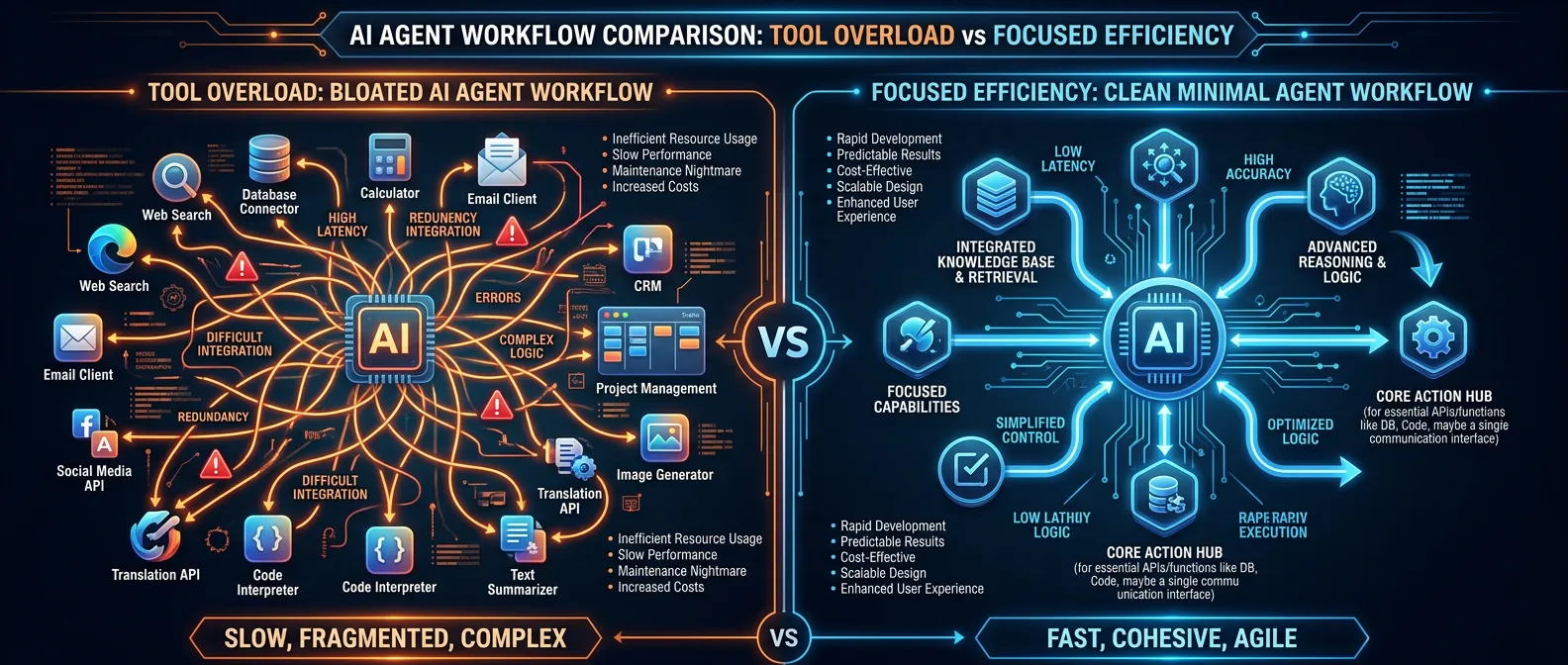
Counter-intuitively, adding more tools to an AI agent makes it perform worse. Every tool is a decision the model must get right — and as tool count grows, decision accuracy drops while inefficiency rises.
The Core Problem
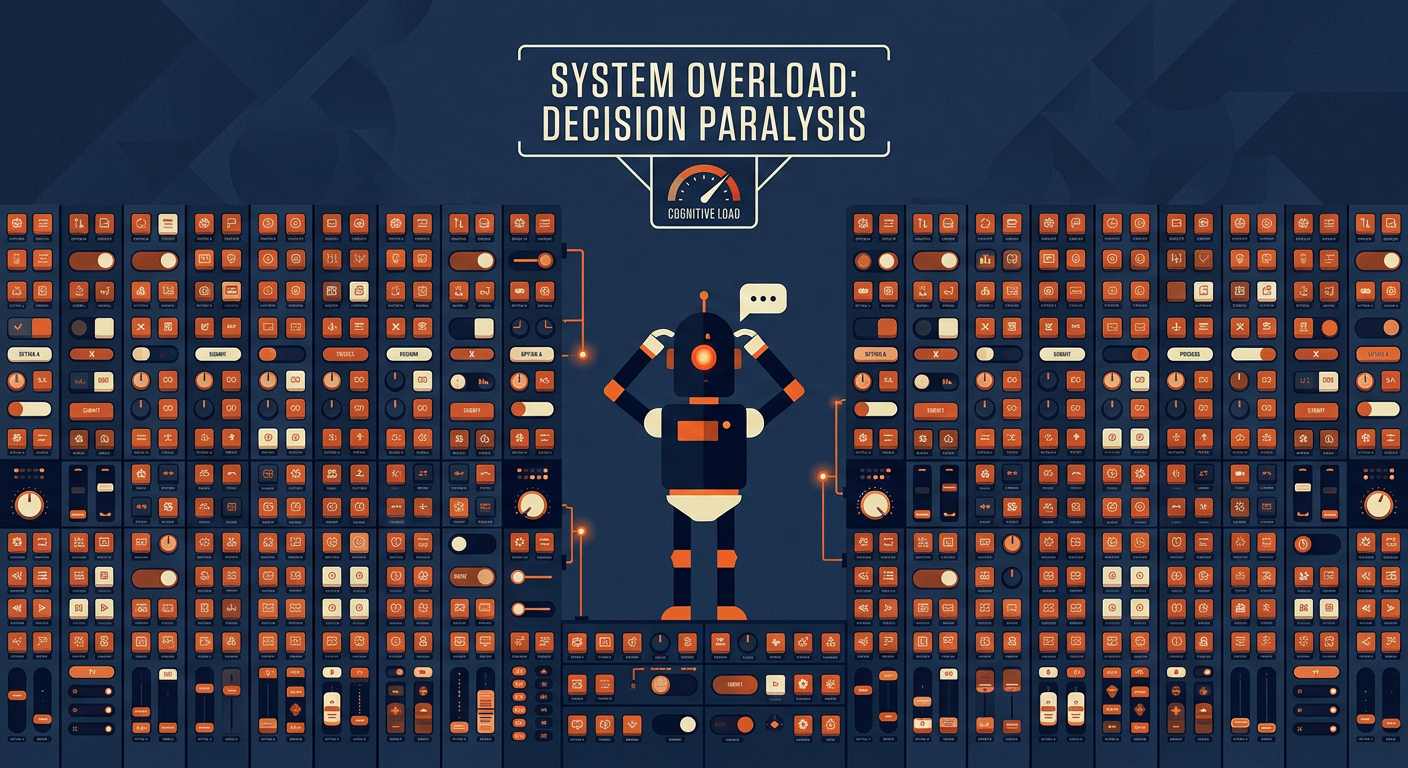
Tools are not just actions. They are context. Each tool injects its description, parameters, and structure into the prompt. Models don’t process everything equally — they prioritize, skip, and compress. The result:
- Important tools get buried
- Irrelevant tools get chosen
- Decisions get noisier
- The agent drifts rather than crashes — it picks “good enough” instead of right
This isn’t randomness. It’s overload.
Key Data
One team removed ~80% of their tools and saw:
| Metric | Before | After |
|---|---|---|
| Success rate | 80% | 100% |
| Execution time | ~275s | ~77s |
| Tokens used | ~102k | ~61k |
| Steps taken | ~12 | ~7 |
They didn’t add intelligence. They removed noise.
Three Compounding Problems
- More comparisons — model spends more time deciding than executing
- More noise — relevant options get buried by irrelevant ones
- More failure chains — more tools = more possible wrong paths
Three Tool Selection Failure Points
- Deciding if a tool is even needed
- Selecting the correct tool
- Using it correctly
All three get worse as tool count increases.
The Solutions
- Limit visible tools per task
- Merge similar tools
- Hide tools unless needed
- Replace repeatable paths with deterministic logic
Optimizer Prompt Framework
“Act as a systems optimizer for agent workflows. Goal: reduce tool-induced failure without reducing the outcome. Input: workflow goal, current tools, tool descriptions. Tasks: find overlapping tools, find tools that create ambiguity, find tools that are rarely needed, identify tools that should be conditional, identify tools that should be replaced with deterministic functions, reduce to minimum viable toolset, rank remaining tools by necessity/risk/likelihood of incorrect selection. Output: failure risks, tools to remove, tools to merge, simplified architecture, why this improves performance.”
Pre-Addition Checklist
Before adding any tool, ask:
- Does this really change the outcome?
- Is there already overlap?
- Will this create confusion?
- Can this be merged?
- What happens if it’s used incorrectly?
Three Buckets Framework
Force every tool into one of three buckets: Retrieval, Transformation, or Action. This constraint prevents sprawl.
Takeaway
The best agents are not impressive. They’re boring. They do one thing, with very few options, and they work every time.
Infographics
Processed: 2026-03-21