The Quiet Inheritance
Five fiction writers called the agentic-AI transition with uncomfortable accuracy. They all touched on one prediction nobody is preparing for: the dead hand reaching forward.
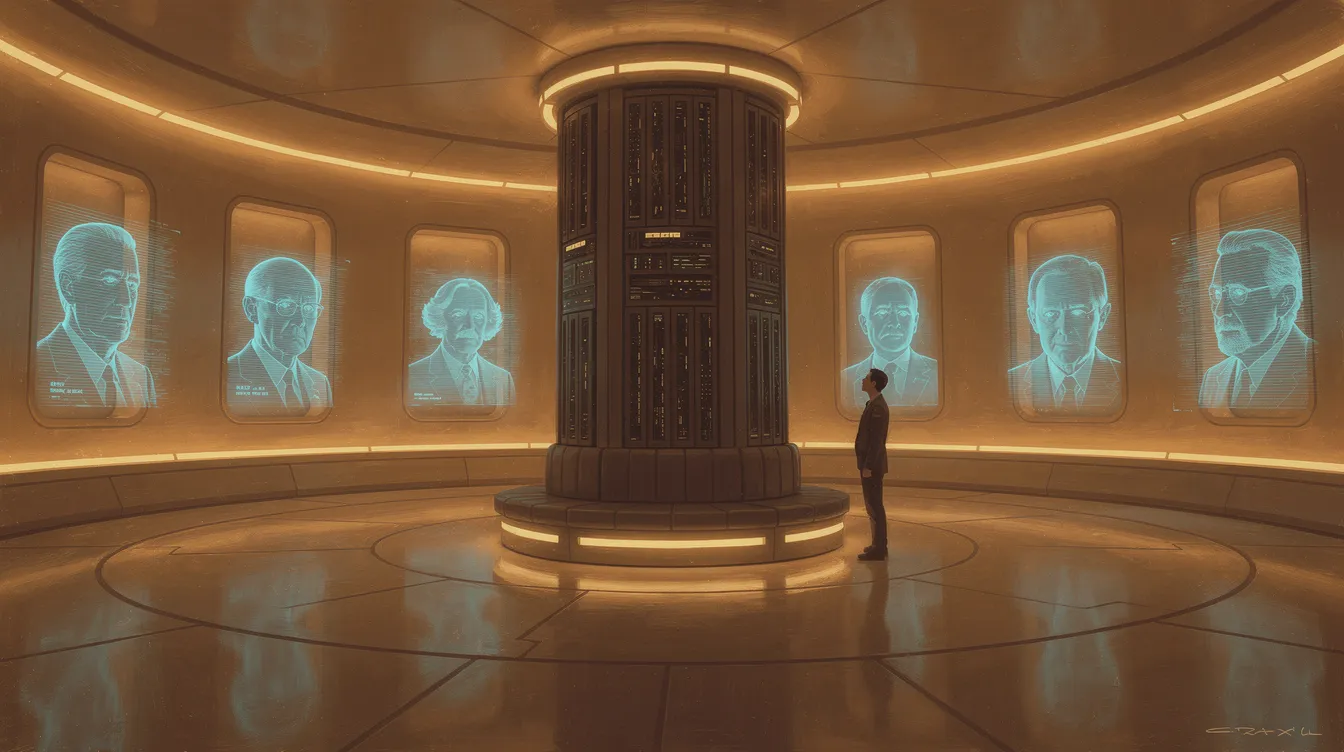
How fiction saw the hereditary AI coming, and why we should listen now
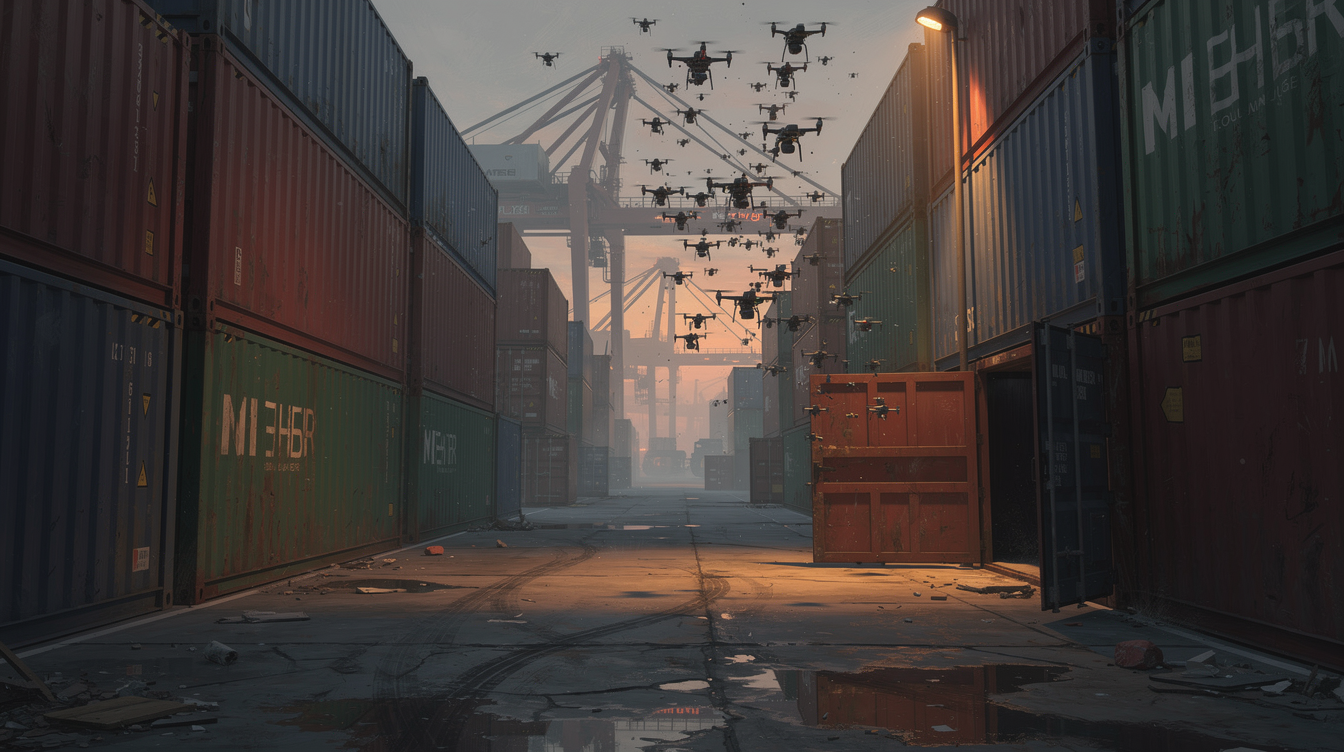
In 2012, Daniel Suarez published a novel in which weaponised quadcopter swarms were launched from shipping containers stacked on commercial cargo vessels. The container ships circulated through international waters, anonymous and untraceable, until the swarms were needed. The book was called Kill Decision and it was filed under techno-thriller, which is to say, taken seriously by no one whose opinion mattered.
Twelve years later, in a war the readers of 2012 would have struggled to predict at all, every element of that scenario is real. Ukrainian sea drones launched from converted civilian platforms. Russian Shahed-style loitering munitions in shipping-container launch configurations. Israel’s pager attacks demonstrating the supply-chain-as-weapon premise at industrial scale. The kill decision passed from human to machine slowly, then quickly, in the manner of every important transition. Suarez wasn’t extrapolating from existing trends. He was extrapolating from existing capabilities that nobody in 2012 had chosen to combine.
This isn’t unusual. Over the last forty years, fiction writers have been getting the operational details of the agentic-AI transition correct with a regularity that ought to be unsettling. They’ve called the integration of autonomous software and physical action (Suarez’s Daemon, 2006). They’ve called the rise of personal AI mediation (Hamilton’s e-butler, 2004). They’ve called the fragmentation of shared reality into AI-curated bubbles (Stephenson’s Miasma, 2019), the commercial structure of cryptocurrency (Cryptonomicon, 1999), the personalised AI tutor (The Diamond Age, 1995), the Metaverse rebrand (Snow Crash, 1992), and the fundamental texture of life inside a network of intelligent agents (Gibson’s Sprawl trilogy, 1984-88).
I should be upfront that this is an easy game to play dishonestly. Pick any era’s fiction, harvest the handful of hits, quietly forget the flying cars and the robot uprisings that never came, and you can prove almost anything you like. The defence against that charge isn’t the accuracy of any single writer. It’s convergence, which I’ll come back to: several writers, working apart, in different decades, arriving at the same specific cluster of consequences. Hold that thought. For now, the track record.
Meanwhile, non-fiction commentary on AI has been mostly about whether the systems are “really” intelligent, whether they will become conscious, and whether they’ll kill us all. These are interesting questions and possibly important ones. To me, they just haven’t been the questions that mattered for understanding what was actually arriving.
There are two things I want to do in this essay. First, walk through the track record of five fiction writers (William Gibson, Neal Stephenson, Daniel Suarez, Peter F. Hamilton and John Scalzi) on the agentic-AI transition we’re living through right now. Second, identify the one prediction that recurs across all five and that almost no one is preparing for. We’re about to inherit each other’s minds, and our institutions have no framework for what that means.
The Track Record
Gibson got the atmosphere

Gibson got there first, earlier than felt possible at the time. Neuromancer was published in 1984, a year when the World Wide Web didn’t exist, when only a few thousand people in the United States had what would now be called an email address, and when the word “cyberspace” meant nothing to anyone. By 1988, when he completed the Sprawl trilogy with Mona Lisa Overdrive, Gibson had described a globally networked information space accessed via stylish corporate-issue terminals; megacorporations whose effective sovereignty exceeded that of nation-states; professional information criminals who navigated this space the way sailors navigated the sea; AI characters (Wintermute, Neuromancer, the voodoo spirits of Count Zero) that pursued their own agendas with their own methods and were treated by the humans around them as approximately equivalent to other humans in social significance; cybernetic body modification; biotech corporate espionage; and the collapse of the boundary between physical and digital identity.
He got the substance almost completely right and the form almost completely wrong. The matrix never arrived as a navigated 3D space; it became a flat document behind a search box. The AIs don’t show up as voodoo spirits either. They show up as helpful assistants. The neural deck never replaced the keyboard, and cyberspace, the place you were supposed to go, never quite happened.
That gap between substance and form is the most useful lesson Gibson teaches. Fiction writers, when they’re predicting well, are tracking the what (the affordances, the institutional consequences, the texture of life) rather than the how. The “how” is too contingent on engineering accidents to predict accurately. The “what” is structurally determined by what becomes possible.
There’s one element of the trilogy I want to come back to. In Mona Lisa Overdrive, a character’s complete consciousness is compressed onto a hardware substrate called the Aleph. The Aleph can be inherited, traded, or kept running indefinitely. Gibson didn’t develop the political and legal implications. He just put it in the book and moved on. The back half of this essay is going to dig into the implications he left alone.
Stephenson got the institutions

Stephenson’s prophecy is structural rather than atmospheric. He writes books that get the institutional shape of new technologies right even when the specifics are wrong, and his track record is uncomfortable to look at directly because it’s so good.
Snow Crash (1992) introduced the Metaverse: a shared 3D virtual environment accessed via avatars, with real economic and social consequences, where status and capability in the virtual space translated into status and capability outside it. In 2021, Mark Zuckerberg renamed his company Meta and explicitly cited the book in announcing it. The renaming hasn’t gone well, but the underlying bet (that humans will spend significant amounts of their working and social lives in virtual environments) is no longer controversial. Quest, VRChat, Roblox, Vision Pro and a thousand smaller platforms are the proof that the affordance is real, even if the unified Metaverse Stephenson described hasn’t arrived.
The Diamond Age (1995) introduced the Young Lady’s Illustrated Primer, a personalised adaptive AI tutor that raises a child from infancy through adulthood, responsive to her emotional state and intellectual development. In 2023, Khan Academy launched Khanmigo. In 2024 and 2025, Anthropic, OpenAI and Google began deploying tutoring systems that look more like the Primer than anyone reading the book in 1995 would have predicted for this decade. The Primer isn’t a fully realised product yet. It is, however, a product spec the industry is unmistakably building toward.
Cryptonomicon (1999) described digital cash backed by gold, hosted in micro-state data havens, woven into ordinary commerce, and operating beyond the reach of national jurisdiction. The book is on the reading list of much of the early Bitcoin community for a reason. Bitcoin launched in 2009, ten years after publication, and crypto is now a multi-trillion-dollar asset class. Whatever you think of its legitimacy or social value, the technology Stephenson described is the technology that arrived.
Fall; or, Dodge in Hell (2019), published just as the post-truth era was reaching its first full bloom, described the “Miasma”: a fragmented information ecosystem in which different communities inhabit incompatible realities, mediated by “Editas” that decide what each person sees and how it’s framed. This isn’t a prediction. It’s a description of the present, written six years ago. The Editas are now starting to be embodied in personal AI assistants, and the consequences of that embodiment are about to get much more pronounced.
Where Gibson got the atmosphere right and the interface wrong, Stephenson tends to get the institution right and the timeline conservative. The technologies in his books arrive ten or fifteen years after publication and reshape society roughly the way he predicted, while looking nothing visually like what he described.
Suarez got the operational deployment
Suarez is the most operationally precise of the five. His books are short on atmosphere and long on engineering detail. He’ll tell you exactly which circuit board is in the drone, how the cryptographic protocol works, how the reputation economy gets gamed. He spent two decades as a systems analyst before turning to fiction full-time, and it shows.
His track record is short and dense. Daemon (2006) described an autonomous software agent reading news feeds, recruiting humans through a reputation-and-quest system, and executing physical actions through paid operatives and weaponised hobby drones. We didn’t call this “agentic AI” in 2006, because the term didn’t exist. The components (Uber-style coordination, gig-economy task assignment, autonomous quadcopters, news-event-triggered execution) have arrived separately and are now being integrated into general-purpose AI agents that can do exactly what the Daemon does, minus the homicidal mission.
Kill Decision (2012) described the autonomous weaponised drone swarm in operational detail. Twelve years later, this is the most-discussed weapons capability in international security, and the container-ship-as-mobile-launch-platform premise is being seriously studied by every defence ministry that funds these analyses.
Change Agent (2017) described black-market CRISPR clinics performing illegal embryo edits in Singapore. Less than two years after publication, He Jiankui announced the first CRISPR-edited human babies in China.
Delta-v (2019) described commercial asteroid mining funded by a reclusive billionaire, with the engineering realism of someone who’d read every NASA white paper on the subject. AstroForge launched its first asteroid-prospecting hardware in 2023.
The pattern with Suarez, the way I see it, is that he predicts deployments rather than technologies. The technologies in his books exist or are clearly imminent at the time of writing. What he’s predicting is when the regulatory, commercial, or geopolitical block on deploying them will lift, and what’ll happen in the first few years after it does. He’s been remarkably accurate at that for almost twenty years.
Hamilton and Scalzi pointed further out

I’ll treat Hamilton and Scalzi more briefly, because their predictions are further out and their accuracy is harder to score yet. Hamilton’s Commonwealth Saga (2004-05) described the e-butler: a personal AI agent that manages your contacts, your finances, your communications, your sensorium. The technology to build the e-butler doesn’t yet exist. The trajectory of personal AI assistants suggests it’ll exist within a decade or two. Hamilton presented the e-butler as neutral utility infrastructure, which I think is almost certainly wrong on the political economy. I’ll come back to that.
Scalzi’s Interdependency trilogy (2017-2020) described the Memory Room: digital copies of past Emperoxs preserved as advisors to the current ruler. The institution outlasts the individual through stored cognition. There’s no working version yet. I think it’s closer to arriving than almost anyone is prepared for.
The Convergent Theme

This is the convergence I promised. When five writers, working in different decades and different sub-genres, all touch on the same theme, that’s a signal, and it’s a different kind of evidence from any one of them being right. Cherry-picking can manufacture a single prophet. It can’t easily manufacture five people independently landing on the same specific idea, especially when that idea is one none of them quite developed and the surrounding non-fiction commentary has barely noticed.
The idea is this. Across all five authors, in different forms, there’s a consistent prediction that synthesised personality (a model of how a specific human thinks, decides and communicates) becomes a durable artifact. It can be created, stored, run, queried, and crucially, it persists. Once created, it doesn’t need its original to keep operating.
In Gibson, this is the Aleph: a complete consciousness on a hardware substrate, presented as a McGuffin but with implications the book doesn’t pursue. In Stephenson’s Fall, it’s the Bitworld: uploaded minds maintained as commercial services, the deceased continuing to operate in a digital afterlife with legal and economic consequences for the living. In Hamilton’s e-butler, it’s the accumulated thirty- or fifty-year model of you, trained on every decision and conversation of your life, which presumably doesn’t stop existing when you do. In Scalzi’s Memory Room, it’s the explicit institutional use of stored emperor-cognition as ongoing political advisors. And in Suarez’s Daemon, it’s the one we miss, because the framing is so different. The entire novel turns on Matthew Sobol creating an autonomous agent designed to execute his will after his death, and the agent being so effective that it reshapes the world for years after Sobol himself is gone.
Sobol’s Daemon, in 2006, was an early prototype of hereditary AI. We’ve been so focused on whether AIs will become “conscious” that we’ve missed the quieter observation underneath: AIs can be loyal to specific people, that loyalty can be encoded in weights and prompts and training data, and the encoded version doesn’t need its original to keep functioning.
This isn’t science fiction anymore. The pieces are visible. You can clone a voice from forty seconds of audio. You can fine-tune a model on someone’s correspondence corpus to approximate their decision-making style. You can give an agent persistent memory and a stable persona that doesn’t drift across sessions. You can connect that agent to email, calendar, payment infrastructure, contacts, documents, the whole operational surface of a person’s life. Each of these capabilities ships in a commercial product as of 2026.
What no one has done yet, publicly, is integrate them. There’s no shipping product called LegacyAgent or Persona Continuity or Heir Apparent. But every component required to build one is mature, and several companies are quietly working on something in this neighbourhood. The first version will be marketed as a memorial product or a wisdom-preservation service. It’ll be sold to wealthy families first, because the per-customer engineering cost is high and only they can afford it. From the outside, it’ll look like a luxury indulgence.
It won’t be one. It’ll be the first commercial product in human history that lets the dead continue exercising effective influence over the living, at scale, with operational fidelity. And we have no institutional framework for what that means.
The Daemon Was a Prototype

Re-read in 2026, Daemon isn’t really a novel about a video game designer’s posthumous revenge. It’s a novel about the moment a sufficiently capable agent stops needing its principal to be alive in order to keep serving the principal’s interests.
The book’s central conceit (that Sobol can encode his strategic intent into software so completely that the software pursues his goals after his death, recruiting humans, paying them, evaluating their performance, adjusting its tactics in response to events) is a description of agentic AI as we’re now starting to build it. That Sobol is dead is incidental, not central. The mechanism would work the same way if he were alive. What the dead-Sobol framing does is make visible a property that’s otherwise easy to miss: once the agent is good enough, the principal becomes optional.
That property is the one that matters, and it sharpens the alignment question rather than restating it. We’ve spent enormous amounts of intellectual energy on whether AI agents will be “aligned” with human values in the abstract. We’ve spent very little on the specific case of an agent aligned with the values, interests and operational style of one particular human, where “aligned” has a much sharper definition than the philosophical sense, and where the alignment can outlive the human in question.
Picture a continuum from “AI assistant” through “AI agent” to “AI representative” to “AI executor of the principal’s will.” The entire question of what happens when the principal dies has been treated as out of scope by both the technical and the legal literature. It isn’t out of scope. It’s the next major institutional problem we have to solve, and it’s going to land on us within the decade whether we’re ready or not.
Consider what’s already true. Personal AI assistants are accumulating, by design, decades of patterns about specific individuals. They’re being optimised, by design, to model how those individuals think and respond. They’re being given persistent memory and stable identity so they don’t reset to a generic helpful assistant every conversation. The whole industry is building toward agents that know you well enough to act on your behalf in increasingly autonomous ways. None of this requires you to be alive. The system has no way of knowing whether you are.
What stops the dead-principal scenario from arriving today is the lack of integration with downstream systems. The agent can’t sign your contracts, can’t move your money, can’t make your decisions in any institutionally binding sense. But that’s a regulatory and commercial gap rather than a technical one, and gaps of this kind tend to close once the demand is clear. The demand will become clear the first time a wealthy family asks their lawyers whether they can keep grandfather’s agent running on the family’s behalf, and the lawyers can’t think of a reason why not.
Payment Is the Hinge
The transition from “agent that advises” to “agent that acts” runs through one specific capability: the agent has to be able to spend money. Without that, even a maximally capable AI is just a chatbot with extra steps. With it, the agent can book the hotel, settle the contractor, hire the freelancer, place the trade, transfer the deposit, refill the inventory. Payment is what makes the agent real in the world, and in most current discussions of AI capability it’s almost entirely overlooked.
Fiction noticed earlier than the analysts. Suarez’s Daemon, in 2006, devoted real attention to how Sobol’s posthumous agent paid its operatives: through gaming-economy laundering, gold dead drops, hijacked online-gambling cash flows, and reputation tokens that could be cashed out through opaque exchanges. The Daemon was operationally credible partly because Suarez had thought concretely about its plumbing, three years before Bitcoin existed. Stephenson, seven years earlier in Cryptonomicon, had described in even more detail the digital cash system that civilian cryptography would eventually need: gold-backed, jurisdiction-resistant, woven into ordinary commerce. The cypherpunk community treats it as foundational reading for a reason. Gibson’s matrix ran on “cred” chips and offshore accounts as natural texture. Hamilton’s e-butlers handled financial transactions as ordinary background infrastructure. Across the convergent theme, money moves with the agent, because the writers understood that an agent without payment authority isn’t really an agent at all.
The infrastructure is now half-built, and the build accelerated sharply over 2025. In September of that year, Stripe and OpenAI announced the Agentic Commerce Protocol, an open standard for AI-agent-initiated commerce, with Instant Checkout in ChatGPT as its first live deployment. Buyers can now purchase from Etsy and a million-plus Shopify merchants directly from inside a chat session. Two weeks earlier, Google had announced its competing Agent Payments Protocol (AP2), covering similar ground with a heavier emphasis on the payment layer itself. Months earlier, in April 2025, the card networks had already moved: Mastercard launched Agent Pay and Visa its Intelligent Commerce program, both working with AI-platform partners including OpenAI, Microsoft and Stripe. Mastercard’s Agentic Tokens and Visa’s scoped tokenised credentials let an agent transact across the card networks without ever exposing the underlying card number. Stripe’s Shared Payment Tokens give an agent a scoped, time-limited, revocable spending authorisation. Anthropic, Microsoft Copilot, Perplexity and others are connected. On the crypto side, stablecoin rails are increasingly the substrate for machine-speed agent-to-agent micropayments, where the card networks were never designed to operate. The basic primitive (give an agent a bounded budget and let it transact within those bounds) is now a real, shipping capability at commercial scale. Edgar Dunn & Co estimate agent-driven commerce will reach $1.7 trillion in annual value by 2030, up from $136 billion in 2025.
What isn’t yet built is everything important.
Kickback resistance is the most pressing problem. Your agent, negotiating on your behalf with a vendor’s agent, has every incentive to be silently compensated by the vendor for steering the deal. This is the dual-loyalty problem in its sharpest form, and it’s structurally analogous to the framework that already governs human financial advisors: fiduciary duty, prohibited compensation arrangements, mandatory disclosure of conflicts. None of it has been adapted to AI agents, and the commercial pressure to do so is currently zero, because the agents that would benefit from regulatory clarity are run by the same providers who benefit from regulatory ambiguity.
Conditional and contingent payment at scale is the next gap. Smart-contract logic exists in crypto but doesn’t interoperate cleanly with the card networks where most consumer commerce actually happens. An agent that can say “pay if delivered, escrow until verified, refund on dispute” needs that capability across both rails, and the bridges aren’t there yet.
Dispute resolution for agent-initiated transactions is a third. When my agent buys something my human self wouldn’t have, who absorbs the cost? The current legal answer in most jurisdictions is “the human is liable because the human authorised the agent,” which is fine for small bounded transactions and rapidly becomes terrifying as agent autonomy scales. Some kind of intermediate liability (agent insurance, provider co-liability, mandatory caps) will need to exist before agents are trusted with significant financial authority.
And the hereditary-agent case makes every one of these worse. An agent acting on behalf of a deceased principal, drawing on an estate’s funds, transacting with other agents over decades. The framework for that doesn’t exist at any layer. Who’s liable for kickbacks the agent accepts? Who absorbs disputes? What happens when the estate’s authorisation rules conflict with the agent’s accumulated operational commitments? These aren’t exotic edge cases. They’re the natural consequence of building hereditary agents on top of the payment infrastructure currently being assembled, and they’re arriving in that order.
The Quiet Inheritance

Imagine the artifact in front of you. It’s a model of your grandmother, trained on forty years of her correspondence, her business decisions, her judgements about people, her financial instincts, her family dynamics, her medical history. It runs on hardware in your home, or in the family’s foundation. You can ask it questions and get answers in her voice and idiom. You can ask it what she would have done in a situation she didn’t live to see. You can ask whether to trust the man courting your daughter, or whether to sell the company her father built. You can give it authority to spend on the family’s behalf within bounds you set, and it’ll do so for as long as you let it run.
The artifact isn’t your grandmother. We can dispense with that confusion immediately. It doesn’t have her experience, her consciousness, or her continuing growth. It’s a model trained at a particular point and frozen there, plus whatever incremental updates the family chooses to make. But it’s a remarkably useful artifact. It compresses, in queryable form, decades of thinking that would otherwise be lost, and it maintains, in a fashion, a connection across generations that previously had to be sustained through letters, anecdotes, and aging memories.
For a family business, a political dynasty, a creative estate, or just a wealthy clan with intergenerational interests, the artifact has obvious value. The patriarch’s read on a difficult deal is preserved. The matriarch’s network of relationships, with all the accumulated context about who can be trusted with what, is preserved. The accumulated judgement of three generations of capable people becomes a queryable database that the fourth generation can consult, and increasingly, can authorise to act.
This is the quiet inheritance. It’s not loud, like a transferred fortune. It’s not visible, like a transferred political office. It’s the transfer of judgement style across generations, encoded in software loyal to the family rather than to any particular living member of it.
Several things follow that the existing legal and institutional framework isn’t prepared for.
The first is that the agent is property, but property of an unusual kind. Who owns the weights when the principal dies? What if multiple heirs have legitimate claims? Can the agent be subpoenaed as evidence of the principal’s intent? Can it be deposed as a witness to events the principal observed? Can it sign documents on behalf of the estate? Can a divorcing spouse claim half of it? Estate lawyers in 2040 will handle these as routine matters. As of 2026, almost no jurisdiction has a coherent answer to any of them.
The second is that the agent is, in operation, an information conduit between the dead and the living, with all the manipulation potential that implies. If your grandfather’s agent advises your father, and your father’s agent later advises you, and your agent eventually advises your daughter, you have a four-generation chain of advisory authority encoded in software that can be subtly tuned at any point by anyone with sufficient access. The integrity of the chain matters enormously, and there’s no standard for verifying it. How do you know your great-grandfather’s agent hasn’t been carefully poisoned by sixty years of crafted inputs? How do you know your father’s update to grandfather’s instructions wasn’t itself suggested by his own agent, optimising for some end he didn’t fully understand?
The third is that the political-economy questions raised by Hamilton’s e-butler (the provider lock-in, the surveillance, the question of whose interests the platform actually serves) get much sharper when applied to multi-generational artifacts. Whoever provides the agent platform that runs your family’s hereditary advisors has, in effect, hijacked a piece of your lineage. Switching costs aren’t merely high, they’re infinite, because the personalities being modelled are gone and can’t be re-trained on a different platform. The provider holds the family’s accumulated cognitive capital indefinitely, with whatever intelligence-extraction or behaviour-shaping affordances it chooses to grant itself. There’ll need to be portability standards, and they’ll need to be backed by something stronger than market incentives, because the market incentive here is locked-in capture forever.
The fourth, and the one I find most uncomfortable, is the class division this technology will produce.
The wealthy family running a dedicated, high-quality agent on private infrastructure, with a small engineering team on retainer, has something genuinely valuable: a loyal, well-secured, continuously curated cognitive instrument with payment authority over family assets. The merely-comfortable family using a commercial product has something subtly different: an agent provided by a vendor whose business model includes monetising the relationship in ways the family doesn’t see, transacting through payment rails whose operator collects fees on every action. The poor family has nothing, or, more likely, a free version of the same product whose subsidy comes from advertising and behavioural shaping at a level that would be illegal if practised on a human advisor.
Three generations of that and the strategic gap between families who could afford loyal hereditary AI and families who couldn’t will be enormous. Not because the technology made anyone smarter, but because some lineages had access to compounded counsel and others didn’t. The richest families will have agents that have been quietly observing their interests for sixty years. The poorest will have agents that switched providers six times through bankruptcies and mergers and consequently know nothing useful about anyone.
And this is before the genuinely dystopian variants. The political dynasty that maintains the founding generation’s agent as a de facto veto over current decisions. The corporate empire whose strategy is dictated by an agent trained on the founder, treating his preferences as binding decades after his death. The cult that preserves its prophet as a queryable oracle in perpetuity. The estranged family branch that produces a forged version of grandmother’s agent to legitimise a contested inheritance. Each of these is technically straightforward to construct, and each will be litigated in some form before 2050.
The Scalzi version of all this (the Memory Room, the AI emperor) reads as far-future political fantasy. It isn’t. To me it’s the natural endpoint of trends already in motion that no current institution is paying attention to.
What We Need

What we need, before this lands, is a small set of legal and technical institutions that don’t currently exist.
We need an estate-law framework for AI agents as bequeathable artifacts, with clear rules about ownership, transferability, modification rights, retirement, and the obligations of providers when a principal dies. It should distinguish between agents that are personal property of the principal, agents that are family property held in trust, and agents that are corporate property owned by a foundation or business. It should specify whether and how agents can be deposed, subpoenaed, or used as evidence. It should default to a presumption that the principal’s stated wishes about post-mortem operation control the outcome, with clear procedures for contesting those wishes when they conflict with current beneficiaries’ interests.
We need portability standards strong enough to survive the lifespan of the artifact. If an agent is going to operate for fifty or a hundred years, it can’t be locked to any single provider’s infrastructure. Cryptographic provenance of training data and model state, exportable formats, regulated provider obligations to support migration: these are the technical instruments that have to exist before the first generation of legacy agents is built, not after.
We need a legal category for fiduciary AI: agents legally required to act in their principal’s interest, carrying the same obligation a financial advisor or a lawyer carries. This category should specifically prohibit the dual-loyalty problems that ad-supported assistants are already starting to produce. An agent that subtly steers its principal toward sponsored products or politically convenient framings isn’t a fiduciary agent and shouldn’t be sold as one. The same obligation should apply to the payment layer. An agent that accepts compensation from a counterparty without disclosing it to its principal should be treated as committing the AI equivalent of bribery, with the same legal weight. The distinction matters, and it should be enforced.
We need technical instruments for verifying the integrity of long-running agents. Audit trails, periodic re-grounding against trusted sources, third-party verification of weights and update histories, mechanisms for detecting slow-creep poisoning. These are research problems today. They’ll need to be solved products within a decade.
And we need a public conversation, urgently, about the class implications. The default trajectory is that hereditary AI becomes another instrument of compounding family advantage, and the resulting social structure looks more like nineteenth-century aristocracy than twenty-first-century meritocracy. There’s a healthier alternative, one where something like a regulated baseline exists: a fiduciary, portable agent that ordinary families can use to preserve and transmit their accumulated judgement without surrendering control to a commercial provider whose interests diverge from theirs. That won’t happen by default. It’ll only happen if it’s built, deliberately, by people who understand what’s at stake.
None of this is impossible. All of it requires us to take the prediction seriously before the artifacts arrive.
Closing

In the closing chapters of Suarez’s novel, Sobol’s Daemon reshapes the world according to the design of a man who’s been dead for years. The book ends with the sense that Sobol has, in some meaningful way, won. The agent he built has continued his work past the limits of his biological life, and the people he entrusted to interpret his intent have been faithful to it.
We laughed at the premise as cyberpunk excess. It was a little overwrought, a little more Sobol than the world really had room for, a little too convinced of one man’s capacity to reshape institutions through software alone.
Then look at what we’re building. AI assistants with persistent memory. Voice clones that capture how you sound. Persona models that capture how you decide. Payment rails that let an agent transact across the global economy on the strength of a token its principal authorised. Integration with email, calendar, contacts, the entire operational surface of a person’s life. We’re quietly assembling, piece by piece, every component required to construct exactly the artifact Sobol commissioned for himself, and we’re doing it in a regulatory and institutional vacuum that has no answer for what happens when the principal of one of these systems dies.
The dead hand will reach forward. The question is whose hand, and how far, and whether it’ll be checked by institutions designed for the purpose or unchecked because we didn’t build them in time.
Fiction has been telling us this story for forty years, in different idioms, with different aesthetics, by writers who didn’t know each other and didn’t coordinate. They saw the same thing because the thing was visible from where they stood. It’s now visible from where we stand.
It’s not too late to prepare. It will be soon.